The ABC’s of Building AI Virtual Agent Solutions
The ABC’s of Building AI Virtual Agent Solutions
A Simple Guide for Marketing Leaders Who Want to Explore Transactional AI Agent Solutions
Let’s start with a simple truth. Most businesses today are not lacking technology. They are overwhelmed by it. Most businesses already have marketing tools. They may use CRM platforms, automation software, analytics dashboards, lead forms, call tracking systems, or customer databases. The challenge is not usually a lack of tools. The challenge is that many tools operate separately, creating fragmented workflows, missed opportunities, slow response times, and operational blind spots. AI Agent Systems help connect and activate those systems more intelligently.
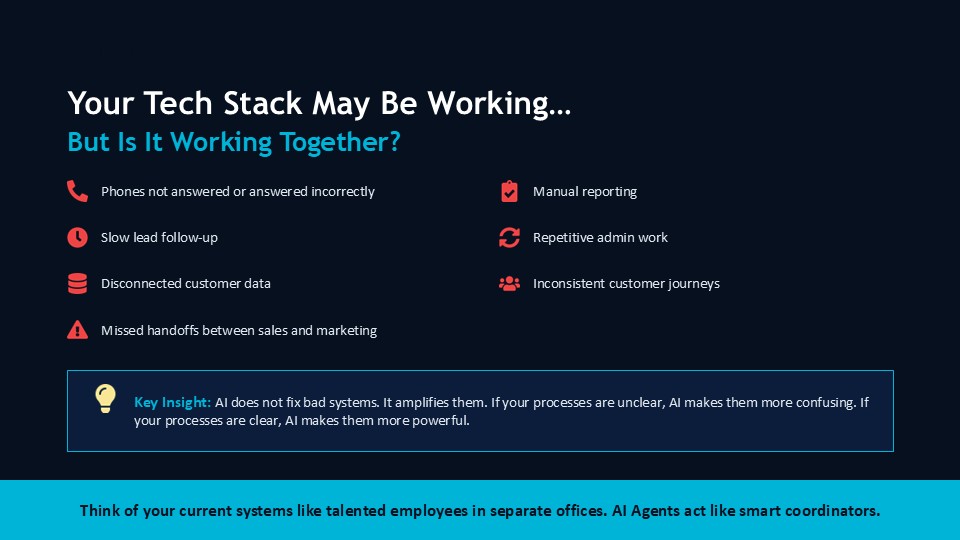
Why This Matters Now - Your Tech Stack May Be Working… But Is It Working Together?
Technology Without Coordination Creates Friction.
Many businesses have invested heavily in platforms like Salesforce, HubSpot, some type of CRM and sales system, email marketing systems, websites, and advertising tools. Yet many still struggle with:
Phones not getting answered or answered incorrectly
Slow lead follow-up
Disconnected customer data
Missed handoffs between sales and marketing
Manual reporting
Repetitive admin work
Inconsistent customer journeys
AI Agent Systems do not necessarily replace your tools. They help your tools communicate, automate decisions, and move faster. Here is the key insight: AI does not fix bad systems. It amplifies them. If your processes are unclear, AI makes them more confusing. If your processes are clear, AI makes them more powerful. This is why many businesses feel disappointed when they first adopt AI. They expect automation. What they get is more noise. Because they skipped the most important step: Clarity.
Simple Analogy:
Think of your current systems like talented employees working in separate offices with poor communication. AI Agents act like smart coordinators helping everyone work together.
First Things First — What Is an AI Agent System?
Let’s slow this down and make it real, because this is where most of the confusion around AI begins, and where the biggest opportunity actually lives. When most people hear the term AI, they still think in terms of tools. They think of something you open, type into, and get a response back from. Maybe it helps write an email, generate content, or answer a question. And while that’s useful, it’s only scratching the surface of what’s now possible.
An AI Agent System is fundamentally different. It is not just software you use. It is a digital worker that operates on your behalf. Think about that shift for a moment. Instead of asking, “What can this tool do for me right now?” the better question becomes, “What work can this system take off my plate entirely?” Because a true AI agent doesn’t sit and wait for instructions every time. It is designed to complete tasks, move information between systems, trigger the next step in a process, and operate continuously across the tools your business already relies on. It behaves less like a passive assistant and more like an active participant in your operations.
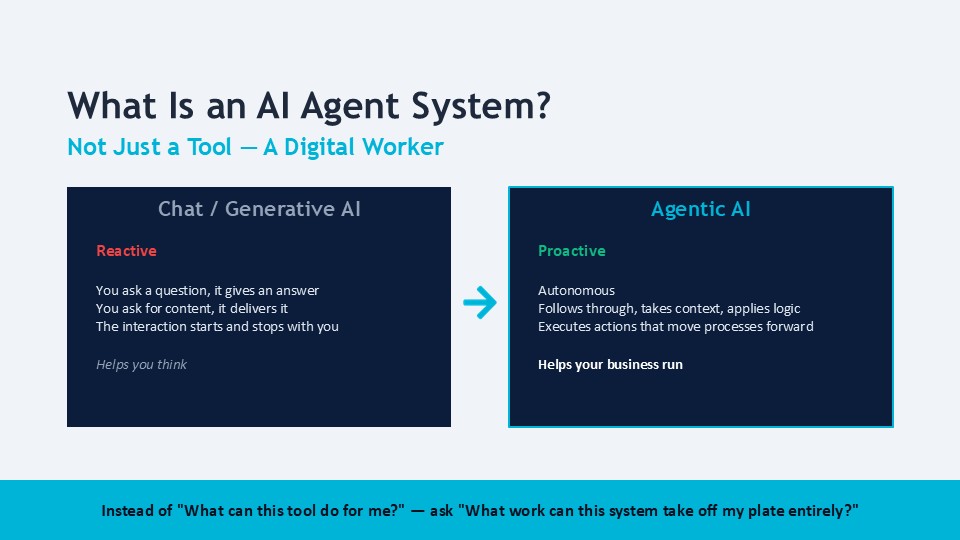
This is where the distinction between traditional AI and agentic AI becomes important. Traditional AI is reactive. You ask a question, it gives you an answer. The interaction starts and stops with you. Agentic AI, on the other hand, is proactive. It doesn’t just respond. It follows through. It takes context, applies logic, and then executes actions that move a business process forward without needing constant human involvement. In other words, it closes the gap between thinking and doing.
To really understand this, imagine a typical scenario that happens in almost every business. A potential customer visits your website and fills out a form. In many organizations, that’s where the delay begins. The form submission might sit in a queue. A notification might get missed. A follow-up might happen hours later, or sometimes not at all.
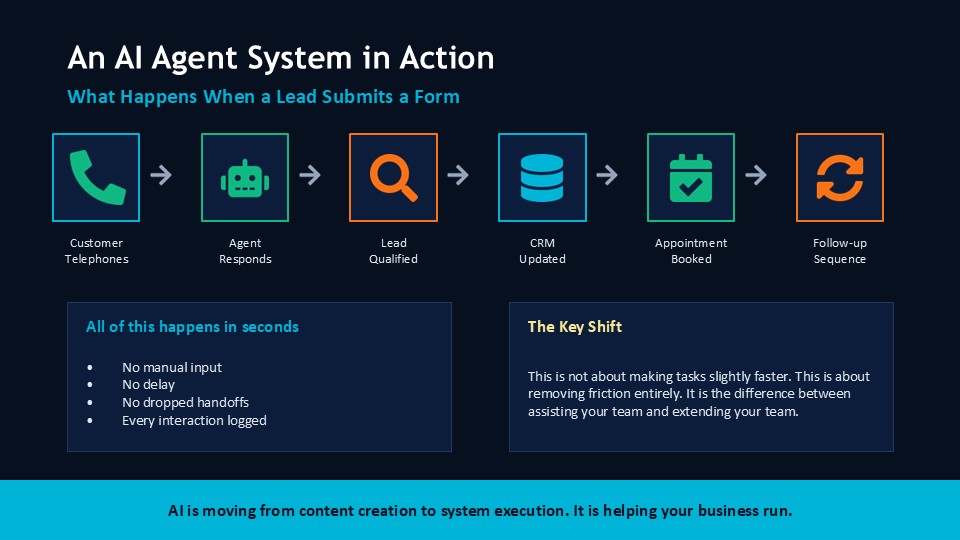
Now imagine that same moment inside an AI Agent System. The instant the form is submitted, the agent responds. Not with a generic auto-reply, but with a contextual, relevant message that acknowledges the inquiry and begins a conversation. At the same time, it evaluates the information provided, qualifies the lead based on predefined criteria, and updates your CRM system—whether that’s HubSpot, Salesforce, or another platform your team already uses.
But it doesn’t stop there. If the lead meets the right conditions, the agent offers available meeting times and books an appointment directly into your calendar. It sends a confirmation message, follows up with reminders, and ensures the prospect actually shows up. Behind the scenes, it logs every interaction, updates records, and triggers the appropriate follow-up sequence so nothing falls through the cracks. All of this happens in seconds. No manual input. No delay. No dropped handoffs. And that’s the key point. This is not about making existing tasks slightly faster. This is about removing friction from the system entirely.
It’s the difference between assisting your team and extending your team. When you start thinking in these terms, AI stops being a feature and starts becoming infrastructure. It becomes part of how your business operates on a daily basis, not something you occasionally turn to when you need help writing or brainstorming. That’s why this shift is so important, especially for small and mid-sized businesses. For years, growth has been tied to adding more people, more tools, or more time. But each of those comes with limitations. People need training and management. Tools require integration and oversight. Time is always constrained.
AI Agent Systems introduce a different model. They allow you to scale execution without proportionally scaling complexity. They create consistency where there used to be variability. They ensure that every lead is handled the same way, every time. They reduce reliance on memory, manual effort, and perfect timing. And they give your human team the ability to focus on higher-value work instead of repetitive tasks. What we are seeing now is a broader shift in how AI is being applied across businesses.
The first wave of AI adoption was largely about content creation. Writing copy, generating images, producing ideas. That wave was valuable, but it was still centered around outputs that required human follow-through. This next phase is different. AI is moving from content creation to system execution. It is no longer just helping you think. It is helping your business run. And the organizations that understand this distinction early are the ones that will gain the most leverage—not because they have better tools, but because they have built smarter systems that actually do the work.
Focus on Outcomes, Not Technology
The Most Important Shift in Thinking
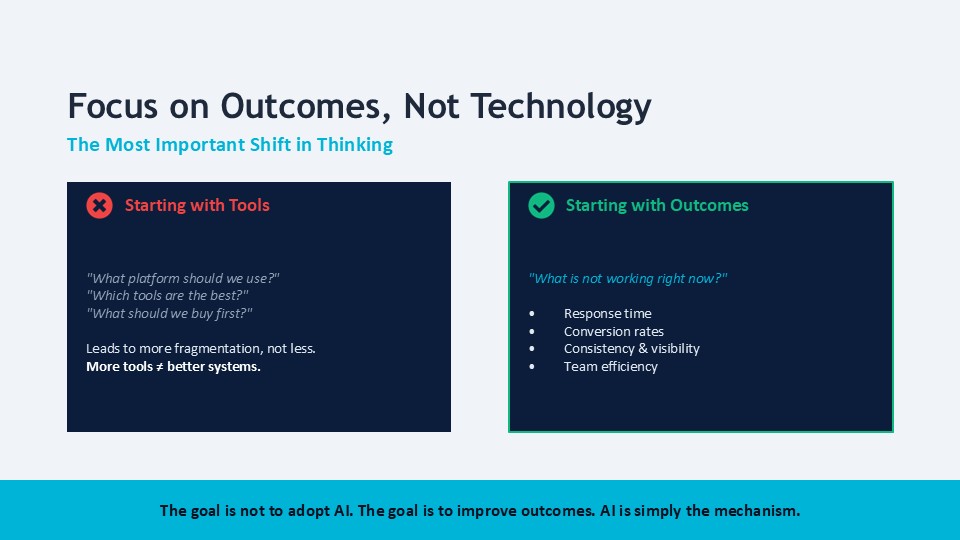
Let’s address the point where most AI initiatives quietly go off track, because it rarely fails in an obvious way. It usually starts with good intentions and ends with unnecessary complexity. The pattern is familiar. A leadership team decides it’s time to “implement AI,” and the first questions that come up sound something like this: What platform should we use? Which tools are the best? What should we buy first? On the surface, those seem like reasonable questions. But they lead the conversation in the wrong direction almost immediately. Because the moment you start with tools, you’ve already skipped the step that actually determines success. You’ve skipped clarity.
What tends to happen next is predictable. Different teams begin exploring different solutions. Marketing tests one platform, sales looks at another, operations considers something else entirely. Each tool promises efficiency, automation, or intelligence. Each one looks useful in isolation. But as they get added into the business, something else begins to happen. The system becomes more fragmented, not less.
Information starts to spread across platforms. Processes become harder to follow. Teams spend more time managing tools instead of improving outcomes. And despite having more technology than ever, the core problems remain unchanged. This is exactly the trap many businesses fall into, and it’s the same pattern highlighted in Part A of this guide.
More tools do not create better systems.
n fact, without a clear objective, they often create more friction. So the shift we need to make is simple, but it’s not always easy. Instead of starting with technology, we start with the business itself. We ask a different question. Not “What should we use?” but “What is not working right now?” That question changes everything. Because when you look at your business through that lens, the answers tend to surface quickly. You begin to notice where momentum slows down, where opportunities get missed, and where your team is working harder than they should have to.
Maybe leads are coming in, but the response time isn’t fast enough to capture attention. Maybe initial conversations happen, but there’s no clear visibility into what happens next. Maybe follow-up depends too heavily on individuals remembering to take action, which means it happens inconsistently. Maybe reporting exists, but it takes too long to compile, so decisions are made without real-time insight. Or maybe your team is simply overwhelmed, spending too much of their day on repetitive tasks that don’t move the business forward. None of these problems are unusual. But each of them points to something important. They are not tool problems. They are outcome problems. And once you define the problem in terms of outcomes, the path forward becomes much clearer. Because now, instead of searching for the “best AI platform,” you are designing a solution to a specific challenge. You are no longer trying to adopt technology for the sake of it. You are applying it with purpose.
This is where the conversation becomes more strategic. Instead of asking what to buy, you begin asking what needs to change. You start thinking in terms of response time, conversion rates, consistency, visibility, and efficiency. You begin to define what success actually looks like in measurable terms.And something else happens when you make this shift. You naturally avoid the trap of tool overload. Because you are no longer chasing features or trends. You are solving problems. And when you focus on solving one clear problem at a time, you tend to use fewer tools, not more. You choose what fits into your system, rather than trying to build your system around whatever tool you’ve just added.
This is a subtle shift, but it has a significant impact. It brings discipline to how decisions are made. It aligns teams around shared outcomes instead of scattered experiments. And it ensures that every piece of technology introduced into the business has a clear purpose tied to performance. At that point, AI stops being something you are experimenting with and starts becoming something that is embedded into how your business operates.
And that brings us back to the core idea. The goal is not to adopt AI. The goal is to improve outcomes. AI is simply the mechanism that helps you do it faster, more consistently, and at a greater scale, but only if you start with clarity about what needs to improve in the first place.
Build Smarter Operations without Starting Over
Let’s address one of the biggest concerns that comes up when marketing leaders begin exploring AI, because it’s often the thing that slows decisions down before they even begin.
There’s a common assumption that adopting AI means starting over. That it requires replacing your current systems, rebuilding your infrastructure, or launching a large, complex IT initiative that takes months, or even years, to complete. And if that were true, the hesitation would make complete sense. Because most teams are already managing enough complexity. The idea of tearing everything out and rebuilding from scratch is not just expensive, it’s disruptive. It pulls focus away from what actually matters, which is growth, customer experience, and performance. But here’s where the opportunity becomes much more practical, and much more accessible.
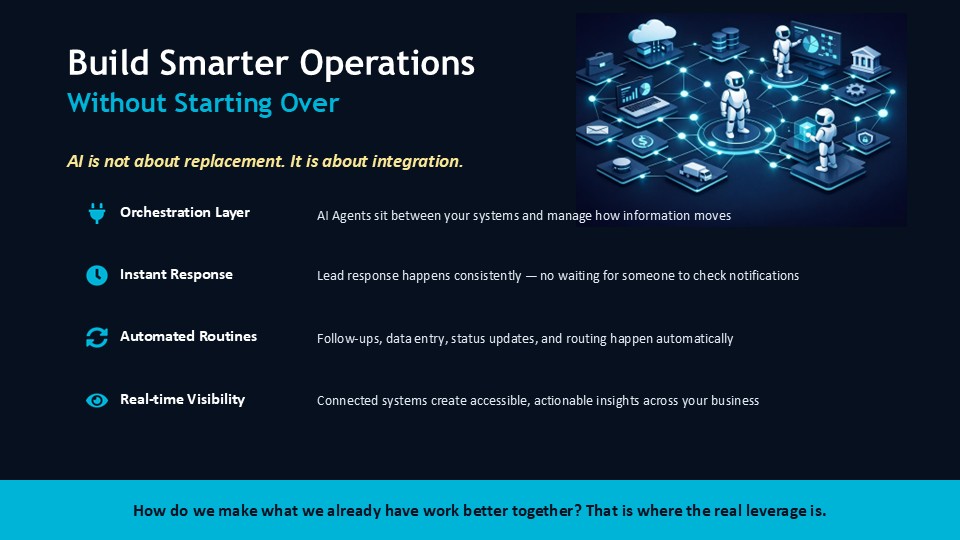
In most cases, AI is not about replacement. It’s about integration. It’s about taking the systems you already have in place and enabling them to work together more intelligently. It’s about creating flow where there is currently friction, and coordination where there is currently disconnect. When you look at your existing stack, whether that includes a CRM like HubSpot or Salesforce, marketing automation tools, communication platforms, and reporting systems, you’ll often find that the core capabilities are already there. The challenge isn’t that these tools can’t perform. It’s that they’re not fully aligned. They operate in parallel rather than in sync.
What AI Agents introduce is a layer of orchestration. They sit between these systems and help manage how information moves, how actions are triggered, and how processes unfold from one step to the next. Instead of relying on manual handoffs or disconnected automations, you begin to create a continuous flow of activity that mirrors how your business actually needs to operate. This is where the shift becomes tangible. Imagine what happens when lead response is no longer dependent on someone checking a notification, but instead happens instantly and consistently. Not just a simple acknowledgment, but a meaningful interaction that begins moving the conversation forward the moment a prospect engages. Or consider what it looks like when your customer journey is no longer fragmented across different touchpoints, but instead feels connected from the first interaction through conversion and beyond. Each step informed by the last, each message relevant to the moment, each action aligned with the overall experience you’re trying to create.
At the same time, think about the amount of repetitive work that exists inside most organizations. Tasks that are necessary, but not strategic. Follow-ups, data entry, status updates, routing requests, managing schedules. These are the types of activities that consume time without necessarily creating value. AI Agents allow you to begin automating those processes in a way that doesn’t just save time, but improves consistency. They ensure that important steps don’t get missed, that timing is optimized, and that execution doesn’t depend on someone remembering what to do next. And as these processes become more connected, something else starts to improve as well. Visibility. Because when systems are working together, data becomes more accessible and more meaningful. Instead of pulling reports from multiple sources and trying to piece together a story, you begin to see a clearer picture of what’s happening across your business in real time. You gain insights that are not just retrospective, but actionable.
All of this contributes to something larger. Scalability. Not in the sense of simply doing more, but in the sense of doing more without increasing complexity at the same rate. You begin to create operations that can grow with your business, rather than becoming bottlenecks as demand increases. And this brings us to the core message of this section.
The real opportunity is not to rebuild your business with AI. It is to refine and orchestrate what you already have. Your current stack likely contains most of the ingredients you need. The systems are there. The data is there. The workflows exist, even if they are imperfect. What AI Agents do is help bring those pieces together. They create alignment where there was separation. They introduce speed where there was delay. And they enable a level of coordination that allows your business to operate more smoothly, more intelligently, and more effectively. So instead of asking what needs to be replaced, the better question becomes: How do we make what we already have work better together?
Because that is where the real leverage is found.
The ABC Framework
A = Assess | B = Build | C = Connect
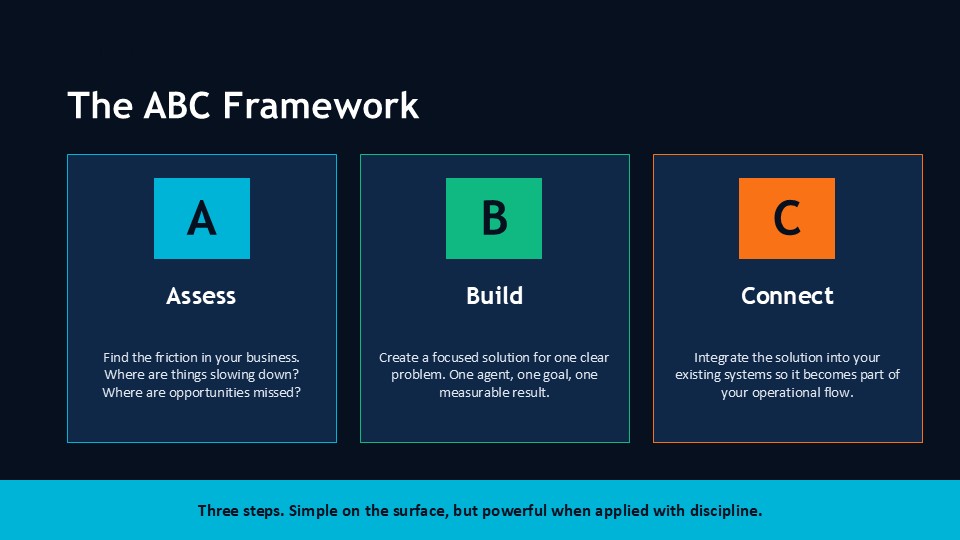
At this point, the question naturally becomes, “How do we actually put this into practice without overcomplicating it?” Because understanding the potential of AI Agent Systems is one thing, but translating that into a clear, repeatable approach is where most organizations get stuck. This is where a simple framework becomes valuable—not as a rigid process, but as a way to bring clarity and direction to what can otherwise feel like an overwhelming set of possibilities.
The framework is straightforward.
A stands for Assess.
B stands for Build.
C stands for Connect.
Three steps. Simple on the surface, but powerful when applied with discipline.
Let’s start with Assess, because this is where everything begins, and it is often the step that gets rushed or skipped. Assessing is not about auditing every piece of technology you have. It’s about understanding where your business is experiencing friction. Where things slow down. Where opportunities are missed. Where your team is working harder than they should have to. This requires stepping back and looking at your operations from the outside in. Not through the lens of what tools you’re using, but through the lens of what your customers and your team actually experience. Where does a lead wait too long? Where does communication break down? Where does information get lost or delayed? Where does manual effort replace what could be a streamlined process?
When you take the time to assess properly, patterns begin to emerge. You start to see that the issue is not isolated. It’s systemic. And more importantly, you begin to identify where a focused improvement could create meaningful impact.
That leads naturally into the second step, which is Build. This is where many businesses are tempted to think big, to design something comprehensive, to try to solve multiple problems at once. But the most effective approach is the opposite. You build with intention, and you build with focus. Instead of asking how AI can transform your entire business, you ask how it can solve one clearly defined problem. One bottleneck. One point of friction that you identified during the assessment phase. The goal here is not to create a perfect system. It’s to create a functional solution that produces a measurable result.
This might be an AI Agent that ensures every new lead receives an immediate and relevant response. It might be an agent that handles appointment scheduling without back-and-forth communication. It might be something that ensures consistent follow-up so opportunities don’t fade over time. Whatever the use case, the key is clarity. You are building something with a specific purpose, tied directly to an outcome that matters to your business. And when you approach it this way, something important happens. The complexity stays contained. The implementation becomes manageable. And the results become visible much faster.
But building the agent is only part of the equation. The third step is Connect, and this is where the real value is unlocked. Because no agent operates in isolation. For it to be effective, it needs to interact with the systems your business already depends on. It needs to access information, update records, trigger actions, and pass context from one stage of a process to the next.
This is what turns a standalone solution into an integrated system. When you connect your agent properly, it becomes part of your operational flow. It doesn’t just perform a task; it moves work forward across your organization. It ensures that when something happens in one system, the right action is taken in another. It creates continuity where there was previous fragmentation. And importantly, this connection step is what allows your initial effort to scale. Because once one agent is connected and functioning effectively, it becomes much easier to introduce additional agents that build on that same foundation. When you step back and look at this framework as a whole, you begin to see why it works. It mirrors how successful AI adoption actually happens in real businesses. Not through massive, all-at-once transformations, but through focused improvements that are built intentionally and integrated intelligently.
You start with a clear understanding of where the problem exists. You build a solution designed to address that problem directly. And then you connect that solution into your broader system so it creates ongoing value. If we simplify it even further, it comes down to a very practical way of thinking.
First, you find the friction.
Then, you fix the friction.
And finally, you connect the system so the improvement becomes part of how your business operates moving forward.
This approach keeps things grounded. It avoids unnecessary complexity. And it creates a path where each step builds on the last, allowing your AI capabilities to grow in a way that is both controlled and scalable. Because at the end of the day, the goal is not to implement AI for its own sake. The goal is to build a business that runs more smoothly, responds more quickly, and operates with greater clarity. And this framework is how you begin to do exactly that.
A = Assess Your Growth Bottlenecks
Clarity Before Automation
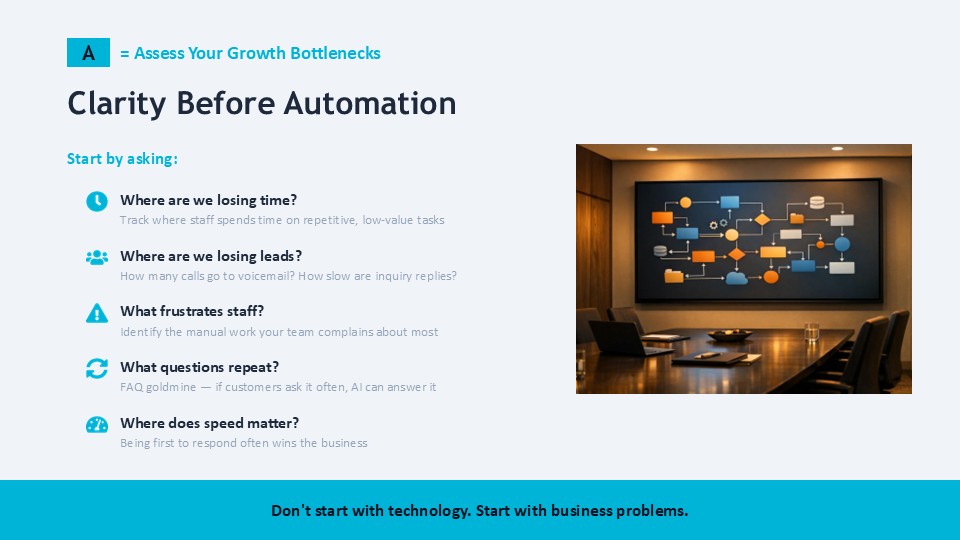
Before anything gets built, before any platform is evaluated, before any automation is turned on, there is a step that determines whether the entire effort will succeed or quietly fall apart—and that step is clarity.
Not technical clarity. Not tool selection. Operational clarity. Because if you automate something that isn’t clearly understood, you don’t fix the problem. You scale the problem. So the first move is not to build. It’s to diagnose.
That means stepping back and looking at your business in motion, not as a set of tools, but as a series of experiences. How does a lead move from first interaction to conversation? How does a prospect become a customer? Where does information flow smoothly, and where does it stall?
When you begin asking those questions, patterns start to emerge. You may notice that leads are coming in consistently, but something happens between that moment and the first response. There’s a delay. Sometimes it’s minutes, sometimes it’s hours, sometimes it depends entirely on who happens to be available. And in that gap, interest fades or disappears entirely.
Or you might see that your team is doing the same work over and over again. Entering data, sending follow-ups, checking statuses, moving information from one place to another. None of it is particularly complex, but it adds up. It consumes time, and more importantly, it introduces inconsistency. Because the more something depends on manual effort, the more likely it is to vary.
Then there’s the customer experience itself. From the outside, it should feel like one continuous interaction with your business. But internally, it often isn’t. A customer might fill out a form, then receive a generic response. They speak to someone who doesn’t have full context. They get asked the same questions more than once. Not because your team isn’t capable, but because the information isn’t connected.
And underneath all of this, there’s a quieter issue that shows up in almost every organization. Too much depends on memory. People remembering to follow up. Remembering to update records. Remembering what happened in the last conversation. When processes rely on memory instead of systems, things slip. Not intentionally, but inevitably.
These are the kinds of issues that don’t always stand out at first glance. On paper, everything might look functional. Leads are being captured. Calls are being made. Reports are being generated. But when you look closer, you begin to see the inefficiencies hiding between the steps.
A lead submits a form, but waits far too long before hearing back. A sales conversation starts without full visibility into prior interactions. Marketing data exists, but it isn’t aligned with what sales is seeing. Follow-ups happen, but only when someone remembers to send them. Individually, these may seem like small gaps. But collectively, they create friction across the entire system. And that’s the key distinction to understand. These are not failures of technology. They are gaps in how the system is designed to operate. Because in most cases, the tools you already have are capable of supporting better outcomes. The issue is not capability. It’s coordination. This is why clarity has to come first.
Because once you can clearly see where the breakdowns are happening, the role of AI becomes much more obvious. You’re no longer trying to apply automation broadly or experiment blindly. You’re targeting specific points where improvement will have a measurable impact.
And there’s a reason experienced operators and practical implementation frameworks consistently point to this as the starting point. The most effective use of AI doesn’t begin with advanced features or complex integrations. It begins with identifying the repetitive, inefficient, or inconsistent parts of your operation—the areas where work is being done, but not in the most effective way.
When you focus there, everything changes.
You stop thinking about automation as a blanket solution and start using it as a precise tool. You begin to see where a faster response would make a difference, where a consistent follow-up would improve outcomes, where connected information would strengthen conversations.
And most importantly, you avoid building on top of confusion. Because once clarity is in place, the next steps—what to build, how to build it, and how to connect it—become far more straightforward. In that sense, this stage isn’t just preparation. It’s the foundation. Because the quality of what you build will always reflect how well you understood the problem in the first place.
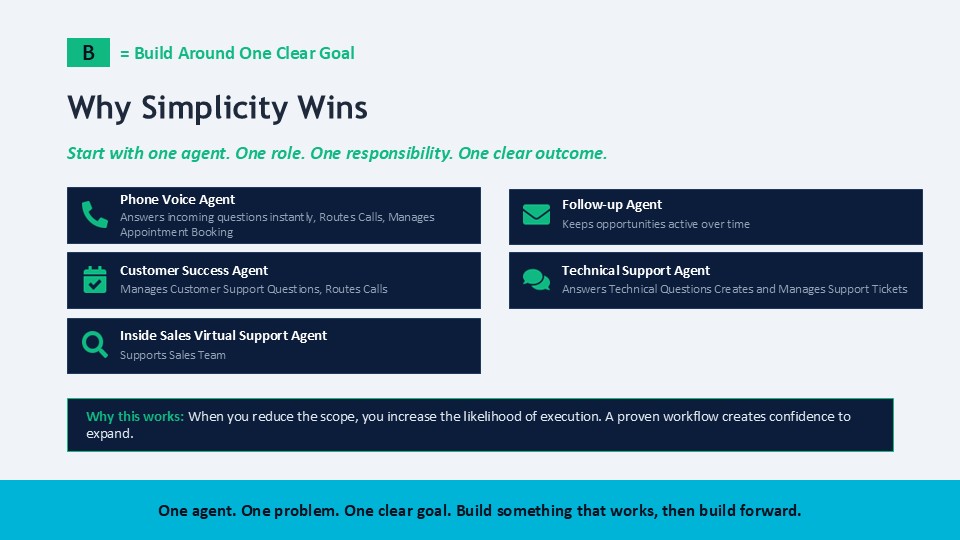
B = Build Around One Clear Goal
Why Simplicity Wins
This is the stage where ideas turn into action, and it’s also where many AI initiatives begin to lose momentum—not because the opportunity isn’t there, but because the approach becomes too ambitious too quickly.
There’s a natural tendency, especially when teams start to see what AI can do, to think bigger. To imagine a fully automated operation, multiple agents working together, entire workflows transformed all at once. On paper, it sounds efficient. It sounds forward-thinking. But in practice, it almost always leads to stalled execution.
Because complexity doesn’t just slow things down. It stops things from getting done. When too many moving parts are introduced at once, clarity fades. Priorities become unclear. Dependencies stack up. And what started as a focused initiative turns into something that feels difficult to manage, difficult to measure, and even harder to complete.
This is why the most effective approach is not to start big. It’s to start precise. Instead of asking how to transform the entire business, the better question is much simpler: what is one problem we can solve completely and effectively? That question forces focus. It brings discipline into the process. And it ensures that what gets built actually delivers value, rather than just adding another layer of complexity. So rather than designing a system with multiple agents from the beginning, you start with one.
One agent with one clearly defined responsibility. Think about the types of roles that already exist inside your business. There’s someone who answers incoming inquiries. Someone who manages scheduling. Someone who qualifies leads before they move into the sales process. Someone who follows up to keep opportunities active. Someone who handles common questions and support requests.
Each of these roles represents a contained function. A specific job with a clear outcome. And that’s exactly how your first AI Agent should be designed. Not as a general-purpose solution, but as a focused system built to perform one of those roles exceptionally well. When you take this approach, something important happens. The problem becomes easier to define. The build becomes easier to execute. And the outcome becomes easier to measure.
Instead of wondering whether your AI initiative is “working,” you can look at a specific result. Are inbound inquiries being handled faster? Are appointments being scheduled without delay? Are leads being qualified more consistently? Is follow-up happening the way it should?
Now you have something concrete. And that’s where momentum begins. Because once that first agent is operating effectively, it creates more than just a solved problem. It creates a foundation. You now have a working model of how an AI Agent functions within your business. You understand how it interacts with your systems, how it fits into your workflows, and how it impacts your outcomes. You have real data, not assumptions. You have a result you can point to.
In other words, you now have a proven workflow. And that matters more than any theoretical plan. Because with a proven workflow comes confidence. With confidence comes clarity about what to do next. And with that clarity, expansion becomes far more intentional. You’re no longer guessing what might work. You’re building on what already does. This is also where repeatability comes into play.
Once you’ve successfully implemented one agent, the process of building the next becomes more efficient. You begin to recognize patterns. You understand how to define the role, how to structure the logic, how to connect it to your systems. What felt new the first time becomes familiar the second time.
And over time, that familiarity turns into a system. Not a collection of disconnected automations, but a structured approach to solving problems with AI. One that can be applied again and again as your business grows. This is why simplicity wins. Not because the problems are simple, but because the path to solving them needs to be clear. When you reduce the scope, you increase the likelihood of execution. When you focus on one outcome, you make success measurable. And when you build step by step, you create something that can scale without becoming unmanageable. So the goal at this stage is not to build everything. It’s to build something that works.
One agent. One problem. One clear goal. Because once that first piece is in place, you’re no longer starting from scratch. You’re building forward with intention.
C = Connect to Your Existing Systems
Integration Is Where Value Happens
This is the point in the process where everything either comes together—or quietly falls apart.
Because building an AI Agent on its own is only part of the equation. It may be functional. It may even be impressive in isolation. But if it doesn’t connect into the systems your business already relies on, then it remains disconnected from where the actual value is created. And that’s where many organizations unknowingly stop short.
They invest time in building something new, but they don’t fully integrate it into what already exists. As a result, the agent becomes another standalone layer instead of becoming part of the operational flow. It performs tasks, but it doesn’t influence the broader system. It responds, but it doesn’t coordinate. It exists, but it doesn’t orchestrate.
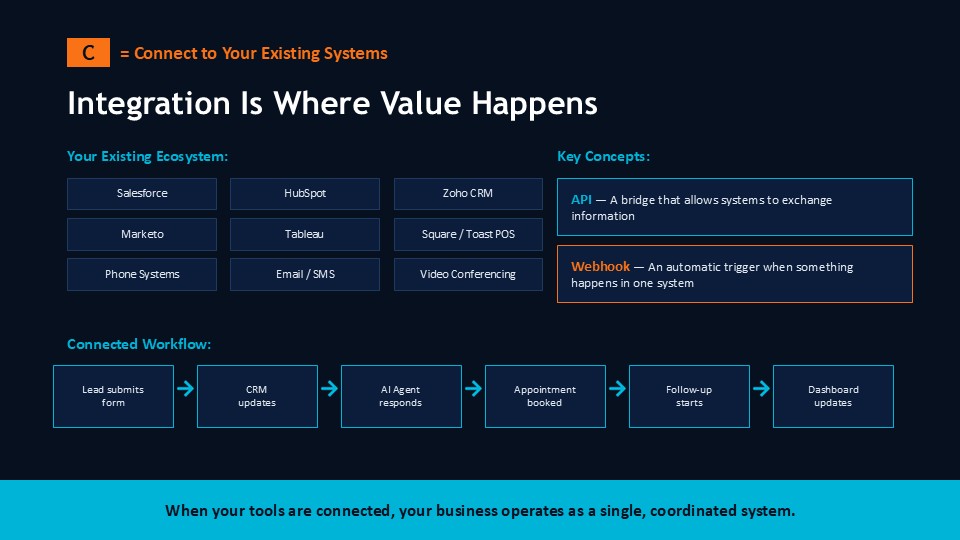
The real power of AI Agent Systems only emerges when everything is connected. Because in most businesses today, the infrastructure is already there. You already have platforms handling customer relationships, marketing activity, communication, and reporting. Systems like Salesforce, HubSpot, and Zoho CRM are already managing core customer data. Tools like Marketo and Tableau are already tracking engagement and performance. Point-of-sale systems such as Square or Toast POS are already capturing transactions. Communication channels like phone systems, email platforms, SMS tools, and video conferencing are already handling customer interaction.
So the question is not whether the tools exist.
They do.
The real issue is that they often operate in isolation. Each system does its job, but they don’t naturally share context with each other. Data lives in separate places. Actions happen in separate environments. And as a result, the customer experience—and the internal workflow—becomes fragmented. This is where integration becomes the most important layer of the entire system. Because once your AI Agent is introduced into this environment, its true value depends on how well it can move between these systems. It needs access to information. It needs the ability to trigger actions. It needs to update records, pass context, and coordinate steps across platforms.
And this is where two foundational concepts become essential to understand. An API is what makes systems able to communicate. It acts as a bridge that allows one platform to exchange information with another in a structured way. Without APIs, systems remain isolated. With them, they can begin to work together. A webhook operates differently but is just as important. Instead of requesting information, it reacts to events. It is an automatic trigger that tells one system that something has happened in another, allowing processes to continue without manual intervention. When you combine these two concepts, you begin to unlock real system-level automation. Because now, actions are no longer dependent on people moving information manually between platforms. They happen automatically, based on defined triggers and shared context.
To make this more tangible, consider a simple customer interaction. A lead submits a form on your website. That event immediately updates your CRM system. The AI Agent recognizes the new entry and responds instantly with a relevant message. It begins a qualification process based on the information provided. If the lead meets the right criteria, it schedules an appointment directly into the calendar. At the same time, it initiates a follow-up sequence to maintain engagement. Every step is recorded and reflected back into your dashboard so the entire organization has visibility into what just happened.
Lead submits a form →
CRM updates →
AI Agent responds →
Appointment is booked →
Follow-up sequence starts →
Dashboard updates
This is not a collection of separate tools working independently. It is a connected system where each action naturally leads to the next. And this is where the real shift occurs. Because once systems are connected in this way, the focus moves away from individual tools and toward overall orchestration. You are no longer trying to optimize each platform in isolation. Instead, you are designing how they work together as a unified process.
This is the essence of what AI Agent Systems enable. They don’t replace your existing tools. They don’t require you to abandon what already works. Instead, they sit on top of your current stack and coordinate how everything interacts. They ensure that data moves when it should. That actions are triggered at the right time. That no step depends solely on manual effort or human memory. And that every system contributes to a larger, more coherent workflow. So the goal is not replacement. It is orchestration. Because when your tools are properly connected, your business stops behaving like a collection of separate functions—and starts operating like a single, coordinated system.
Understanding Multi-Agent Systems
From Automation to Systems Thinking
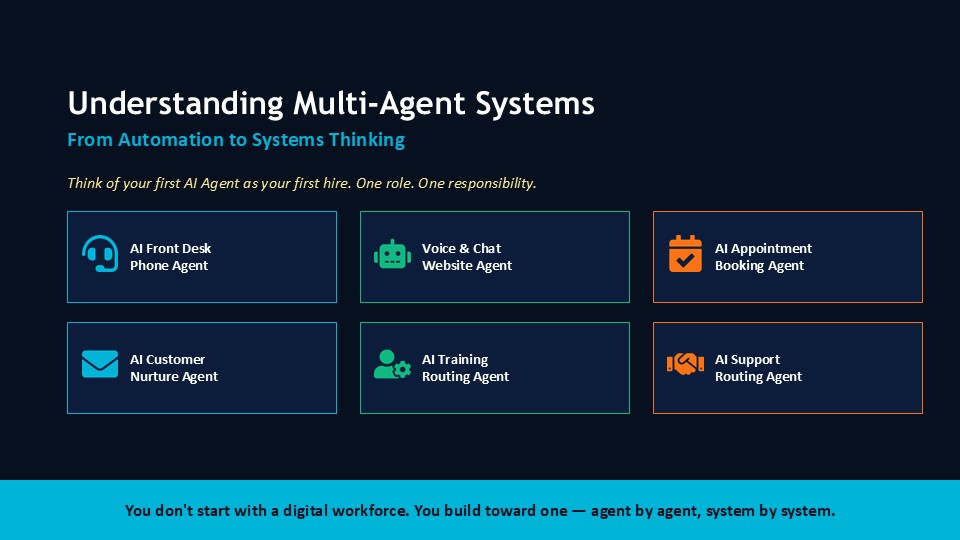
It helps to re-frame how you think about your first AI Agent, because the way you conceptualize it determines how successfully you will scale it. In most cases, your first AI Agent should not feel like a complex system or an advanced architecture. It should feel much simpler than that. Think of it as your first hire.
Not a team. Not a department. Just one person.
One role. One responsibility. One clear outcome.
And the expectation is straightforward: it does that job well.
Nothing more, nothing less.
This is an important mental shift, because when businesses first explore AI, there is often a tendency to imagine the end state immediately. Fully automated systems, interconnected workflows, multiple agents coordinating across every function of the business. But that vision, while valid, is not where you begin.
It is where you arrive. Because as your business grows, and as your understanding of how these systems behave deepens, something natural begins to happen. You stop thinking in terms of isolated automations and start thinking in terms of systems. The perspective changes from building individual tools to designing how work flows across roles, responsibilities, and outcomes.
At that point, your architecture evolves in stages. You move from a single agent, to multiple agents, and eventually to a coordinated system. At the beginning, there is one agent performing one function. It might be handling inbound inquiries, qualifying leads, or managing appointment scheduling. Whatever its role, its purpose is clearly defined, and its scope is intentionally limited.
Once that agent is stable and delivering consistent value, you begin to introduce additional agents—not randomly, but strategically. Each one is designed to handle a specific part of the broader customer or operational journey. For example, you might have an AI Front Desk Phone Answering Agent that manages inbound calls and ensures every inquiry is captured and directed appropriately. Alongside that, a Voice and Chat Agent integrated across your website that engages visitors in real time and helps guide them toward the next step. You might introduce an AI Appointment Booking Agent that removes friction from scheduling and ensures availability is always aligned with demand.
From there, you could expand into an AI Customer Nurture Agent that maintains ongoing communication with leads who are not yet ready to convert, keeping them engaged over time without manual follow-up. You might also implement an AI Training Routing Agent that ensures internal requests or onboarding processes are directed to the right resources or systems. And a Support Routing Agent that handles incoming service requests and ensures they reach the appropriate resolution path quickly and efficiently.
Individually, each of these agents is focused. Each one has a clear job, a defined input, and a predictable output. But when they are connected, something more powerful emerges.
They begin to function as a digital workforce. Not a collection of tools, but a structured system of specialized agents working together to support different parts of the business. Each one handles its own responsibility, but all of them contribute to a larger operational flow. However, it is important not to misunderstand this as the starting point. Because this level of coordination does not happen on day one. You do not begin by building a fully formed multi-agent system. You build toward it.
The progression is intentional. It starts with one agent proving value in a real business environment. Then another is introduced to support a related function. Over time, these agents begin to interact, share context, and operate within a shared system of logic and data. Eventually, what emerges is not just automation, but structured intelligence across your operations. This is where systems thinking becomes essential.
You are no longer thinking in terms of isolated tasks or individual efficiencies. You are thinking about how work moves through your business as a whole. How information flows from one stage to another. How decisions are triggered. How outcomes are created through coordination rather than manual effort.
And this is where the true scalability appears. Because a single agent improves a single process. But a coordinated system of agents improves the entire operational model. The key outcome of this progression is not just automation. It is the introduction of specialization at scale. Each agent becomes highly focused on a specific role, which reduces ambiguity and increases consistency. And when those specialized roles are connected, the overall system becomes more efficient, more responsive, and more capable of handling growth without increasing operational strain.
So the important takeaway is simple. You don’t start with a digital workforce. You build toward one. Step by step. Agent by agent. System by system. Until what you’ve created is not just automation, but a structured, scalable operational ecosystem that works alongside your business and grows with it.
What Is an MCP Server?
The “Mission Control Center” for Smarter AI Systems
As your AI system begins to grow beyond a single agent, something important starts to change. What was once simple and contained becomes distributed. You are no longer dealing with one AI performing one task inside one workflow. You are now working with multiple agents, each responsible for different parts of the business process. One might be handling incoming leads, another managing scheduling, another supporting follow-up communication, and another updating records across your CRM.
Individually, each agent may function perfectly. But collectively, a new challenge emerges. Coordination. Because once multiple agents are operating at the same time, they are no longer just performing tasks in isolation. They begin to interact with shared systems, shared data, and sometimes even overlapping responsibilities. And without a structured way to manage that interaction, things can start to become inconsistent.
Data may not always flow correctly between agents. One agent may act on outdated information while another is already working with updated context. Tasks may get duplicated. Or worse, certain actions may never get triggered at all because no system is clearly responsible for initiating them. This is the point where complexity doesn’t come from the agents themselves, but from how they relate to each other. And this is exactly why a coordination layer becomes essential. This is where MCP comes in.
MCP stands for Model Context Protocol.
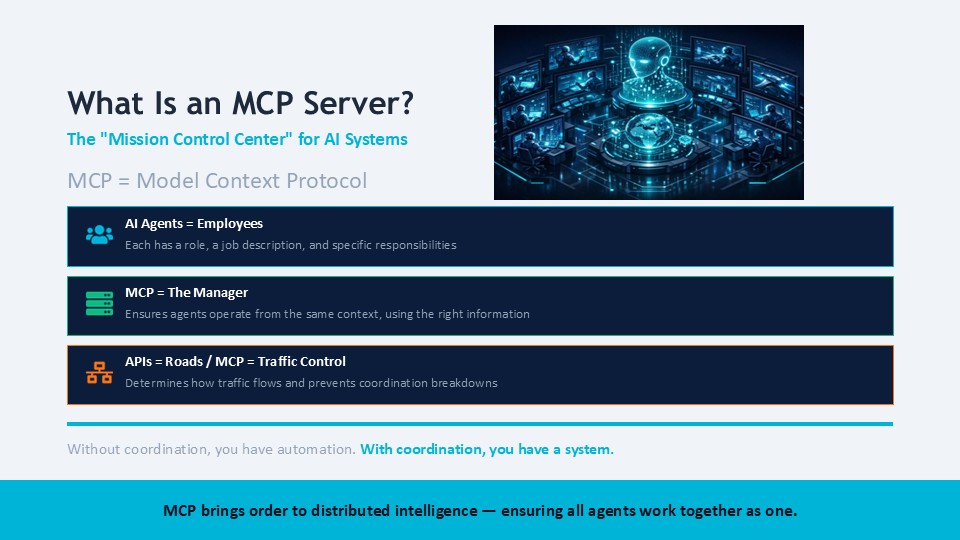
Now, for most business leaders, that term can sound technical or abstract, but the underlying idea is actually quite simple when you translate it into operational terms. Think of MCP as the mission control center for your AI system. It is the layer that ensures all of your agents are not only functioning individually, but also working together intelligently as a unified system.
To make this easier to understand, imagine your AI agents as employees inside a growing organization. Each employee has a role, a job description, and specific responsibilities. One works in sales, another in customer support, another in operations. Each one knows what they are supposed to do.
But as the organization grows, simply having employees is not enough. You also need structure. You need coordination. You need a way to ensure that information is shared correctly, that priorities are aligned, and that work is distributed efficiently.
In that analogy, MCP is the manager. It doesn’t replace the employees. It doesn’t do their jobs for them. Instead, it ensures they are all operating from the same context, using the right information, and moving in the same direction. It acts as the connective intelligence layer between agents.
So when one agent receives new information, MCP helps determine how that information should be shared across the system. When multiple agents need to act on the same data, MCP ensures they are not duplicating effort or working in conflict. When priorities shift, MCP helps reorient the system so that the most important tasks are handled first.
In other words, it brings order to distributed intelligence. To make the concept even more intuitive, you can think about it in terms of infrastructure. If individual AI agents are like vehicles moving through a system, then APIs are the roads that allow those vehicles to travel between destinations. They define where information can go and how systems can connect.
But MCP is not just another road. It is the traffic control system. It is what determines how traffic flows, when systems should communicate, and how to prevent congestion, overlap, or breakdowns in coordination. It ensures that every movement within the system happens with awareness of everything else happening around it.
Without that layer, each agent may still function, but the system as a whole becomes unpredictable. Actions may still occur, but they may not align. Processes may still run, but they may not be synchronized. And as complexity increases, that lack of coordination becomes more difficult to manage.
With a coordination layer in place, however, everything changes. Now agents are no longer acting independently without awareness. They are operating within a shared context. They understand what other parts of the system are doing. They have access to consistent information. And they can adjust their actions based on the overall state of the system. This is what allows AI systems to scale beyond simple automation. Because scalability is not just about adding more agents. It is about ensuring those agents can work together without creating friction or fragmentation. When coordination is strong, systems become stable even as they grow. Workflows remain consistent. Data remains reliable. And operations can expand without breaking down. But when coordination is weak or absent, even small systems begin to behave unpredictably as they scale.
So the role of MCP is not just technical. It is structural. It defines how intelligence flows through the system. It ensures that context is preserved, that actions are aligned, and that the entire network of agents behaves as a cohesive operational unit rather than a collection of independent tools. And that is the key distinction. Without coordination, you have automation. With coordination, you have a system.
The Practical Path Forward
At this point, it’s important to shift from concepts to execution, because even the clearest understanding of AI Agent Systems doesn’t create value until it is applied in a structured way. he reality is that most organizations don’t struggle with ideas. They struggle with where to begin, how much to build at once, and how to avoid creating unnecessary complexity in the process. This is why having a practical path forward matters. Not as a rigid methodology, but as a way to reduce noise and bring focus to the implementation process.
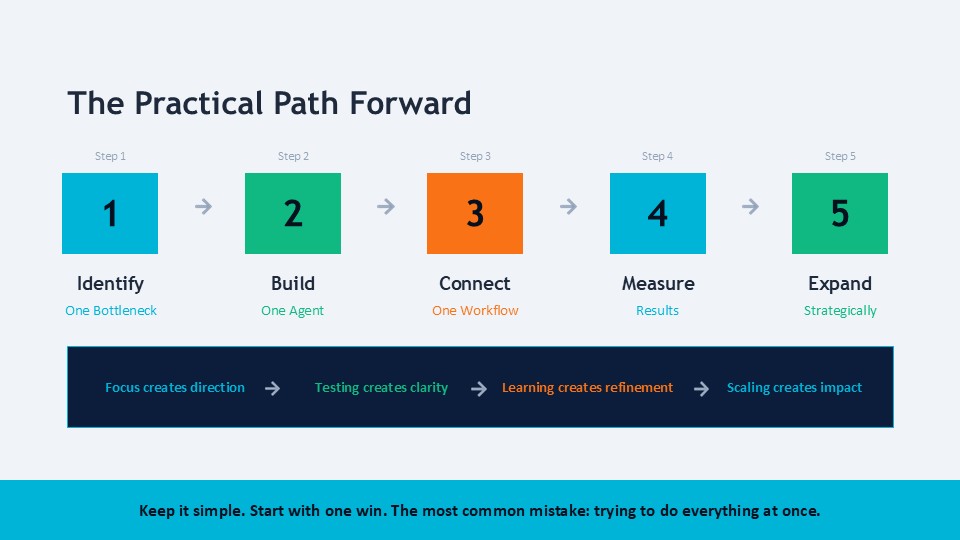
A proven approach begins with five simple phases, each one building on the last in a controlled and intentional way. The first phase is to identify one bottleneck. Not multiple bottlenecks. Not a full operational audit across every department. Just one. One point in your business where friction is clearly visible and consistently felt.
It might be slow lead response. It might be inconsistent follow-up. It might be manual scheduling. It might be a breakdown in communication between systems. The key is not to solve everything at once, but to isolate one problem that, if improved, would create meaningful impact. This step is critical because it anchors the entire process in reality. It ensures that what you build is tied to something specific, measurable, and relevant to the business. Once that bottleneck is clearly defined, the next phase is to build one agent.
This is where focus becomes essential. Instead of designing a broad system that attempts to solve multiple problems simultaneously, you build a single AI Agent that addresses that one identified friction point directly. That agent is not abstract or theoretical. It has a defined role inside your business. It performs a specific function. It responds to a specific trigger. It produces a specific outcome. At this stage, simplicity is not a limitation. It is a strength. Because a focused system is far easier to test, refine, and improve than a complex one.
Once the agent is built and functioning, the next phase is to connect one workflow. This is where the agent moves from being a standalone capability to becoming part of your operational system. It is integrated into the tools and processes your business already uses. It begins interacting with your CRM, your communication channels, your scheduling tools, or your reporting systems. This connection is what transforms the agent from a useful feature into a functioning part of your business infrastructure. It ensures that actions are not isolated, but instead flow into the broader system in a consistent and reliable way.
After the workflow is connected, the next step is to measure results. This is where clarity becomes critical again, because without measurement, it is impossible to understand whether the system is actually improving performance. At this stage, you begin evaluating the impact of the agent in real operational terms. Are response times improving? Is follow-up more consistent? Are fewer opportunities being lost? Is the workload on your team decreasing? Are customers experiencing smoother interactions?
These measurements are not just technical metrics. They are business outcomes. And they determine whether the system is delivering real value or simply adding another layer of complexity. Finally, once results are clear and the system is stable, you move into the expansion phase. This is where additional agents can be introduced. Not randomly, but strategically. Each new agent is designed to address another clearly identified bottleneck, building on the foundation that has already been established. Over time, what begins as a single improvement evolves into a coordinated system of agents, each contributing to different parts of the business while remaining connected through shared workflows and context.
When you look at this process as a whole, a pattern becomes clear. It mirrors how successful AI adoption actually works in practice. It is not driven by scale at the beginning. It is driven by focus. You start small, you test in real conditions, you learn from actual performance, and then you scale based on evidence rather than assumptions.
Focus creates direction.
Testing creates clarity.
Learning creates refinement.
And scaling creates impact.
This progression is what prevents AI initiatives from becoming overwhelming or unfocused. It ensures that every step forward is grounded in something that has already been validated. And just as importantly, it helps avoid one of the most common and costly mistakes in AI adoption. Trying to do everything at once. Because when everything is prioritized, nothing is truly prioritized. Systems become too complex to manage effectively, and progress slows instead of accelerating. But when you follow a structured, phased approach, each step builds confidence, reduces uncertainty, and creates a clear path toward scalable, sustainable improvement. That is what makes this approach practical. Not because it is simplistic, but because it is disciplined.
Final Takeaway
Build Smarter, Not Harder
As we bring everything together, it helps to return to the simplest version of the idea we’ve been building toward throughout this entire framework. Most businesses today are not struggling because they lack software. In fact, in many cases, they already have more tools than they actually need. There are CRMs managing customer data, marketing platforms running campaigns, analytics tools tracking performance, communication systems handling conversations, and automation tools attempting to connect the gaps between them.
On paper, it looks complete. But in practice, it often feels disconnected. Because having tools is not the same as having coordination. And that is the real issue underneath most operational challenges in modern businesses. It is not a lack of capability. It is a lack of connection between capabilities. This is where AI Agent Systems create their value—not by replacing what you already have, but by helping it work together more intelligently.
Instead of introducing yet another disconnected layer of software into your stack, AI Agents act as the coordination layer that brings your existing investments into alignment. They help information move more fluidly between systems. They reduce the need for manual handoffs. They ensure that actions in one part of your business naturally trigger the right actions in another. And when that happens, something important changes. Your business starts to feel simpler again. Not because the underlying operations have become less sophisticated, but because the complexity is being managed in the background rather than exposed to your team at every step.
This is where clarity begins to improve. Where response times shorten. Where follow-up becomes consistent instead of variable. Where reporting becomes more immediate and more reliable. Where your team spends less time managing systems and more time focusing on meaningful work.
So when we talk about AI Agent Systems, the core idea is not expansion for its own sake. It is refinement. It is about taking what already exists and making it work better together. And that leads us back to a simple but powerful closing framework.
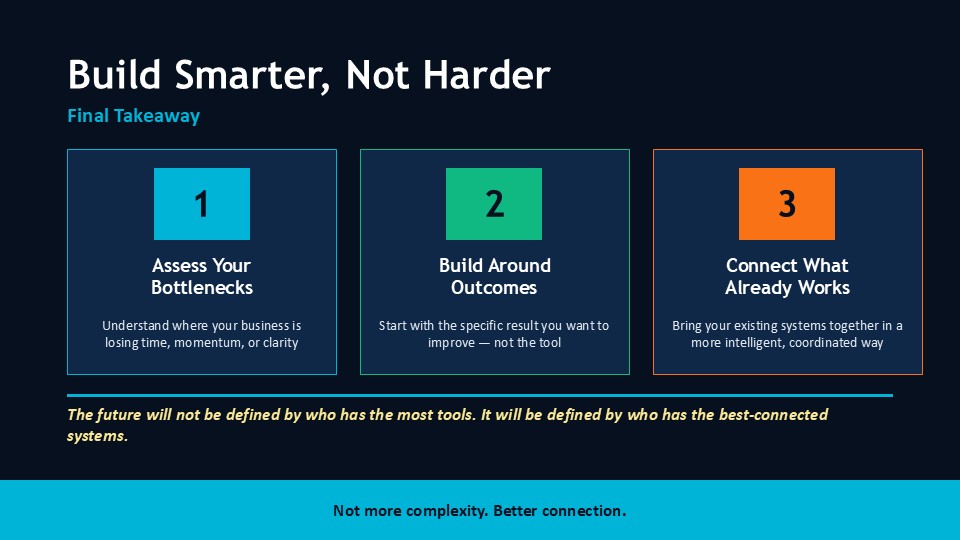
First, assess your bottlenecks. Understand where your business is losing time, momentum, or clarity. Identify where friction exists in your current workflows—not at a surface level, but at the points where performance actually breaks down.
Second, build around outcomes. Do not start with tools or platforms. Start with the specific result you want to improve. Whether that is faster response times, better lead conversion, more consistent communication, or reduced operational load, the outcome should define the solution—not the other way around.
And third, connect what already works. Because in most cases, the foundation is already there. The systems are already in place. The data already exists. The workflows are already partially built. The opportunity is not to replace them, but to bring them together in a more intelligent and coordinated way. When you apply those three principles consistently, the approach to AI shifts from experimental to operational. From fragmented to structured. From reactive to intentional.
And that brings us to the final thought. The future of marketing, sales, and operations is not defined by who has the most tools. It will be defined by who has the best-connected systems. Systems that communicate clearly. Systems that respond quickly. Systems that reduce friction instead of adding to it. Systems that allow businesses to move faster, serve customers better, and grow with greater stability and less operational strain. That is the real direction this is moving in. Not more complexity. Better connection. And once that connection is in place, everything else becomes easier to scale.