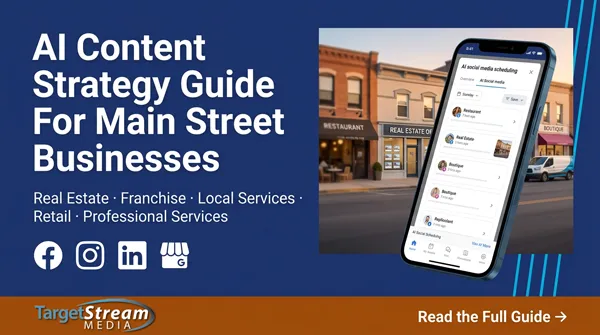
AI Content Strategy for Local Businesses
AI, Social Media, Small Business Marketing
AI Social Media Content Creation and Strategy Guide for Main Street Businesses
Social media in 2026 moves faster than most Main Street businesses can reasonably keep up with. AI now underpins the workflows of nearly all social media professionals, yet many local businesses still rely on manual posting, scattered tools, and ad hoc planning. This guide explains how Target Stream Media’s Ask AI platform helps Main Street owners and managers turn AI into a practical, safe, and strategic advantage—without losing the authenticity customers expect from local brands.
1. The Reality for Main Street: A Working Tech Stack That Is Not Working Together

Most Main Street businesses have quietly built a technology stack over the last decade. A point-of-sale system here, an email platform there, a scheduling tool, an online ordering app, maybe a basic CRM, and of course multiple social media accounts. On paper, the stack “works.” In practice, it rarely works together in a coordinated way that supports consistent, strategic marketing.
The result is a familiar pattern: the owner or manager becomes the de facto social media department. Posts are created late at night or early in the morning, often rushed, sometimes duplicated across platforms, and occasionally forgotten altogether. Each network—Facebook, Instagram, TikTok, LinkedIn, Google Business Profile—demands its own timing, format, and tone. Without a unified workflow, the manual posting burden quickly becomes unsustainable, especially when paired with staffing, operations, and customer service responsibilities.
At the same time, AI-generated content is everywhere. Industry reports show that more than 90% of marketers now use AI tools in their social workflows, often every day. That means your local competitors can create more content, more quickly, and test more ideas than ever before. Yet audiences are also increasingly wary of generic “AI slop” and reward brands that remain human, specific, and grounded in real experiences. Authenticity, not volume alone, is the differentiator.
This is where a strategic question becomes critical: your tech stack may be working, but is it working together? If your POS, website, email, and social channels are not feeding a coherent content strategy, you are leaving reach, engagement, and revenue on the table. Target Stream Media’s Ask AI platform is designed specifically to close this gap for Main Street businesses by turning fragmented tools into one coordinated, AI-assisted content engine.
2. The Ask AI Workflow: From Template to Calendar in a Few Guided Steps
Ask AI is built to mirror how Main Street teams actually work: quick, structured steps that remove guesswork, protect your brand, and save hours each month. The workflow focuses on four core elements—template selection, platform selection, AI caption writing, and conflict-free scheduling—brought together in a clear calendar view so managers always know what is going out and when.
Template Selection: Start with a Proven Structure
Instead of starting from a blank screen, Ask AI guides you to select a template that matches your objective: promotion, event, announcement, education, hiring, review highlight, seasonal campaign, and more. Templates embed best practices for length, tone, and call-to-action, so even non-marketers can move quickly while staying on brand. You add simple inputs—offer details, dates, images you plan to use, or a few bullet points—and Ask AI does the heavy lifting from there.
Platform Selection: Right Message, Right Network
Each social platform has its own norms. A short, punchy post may excel on X, while a more visual carousel works on Instagram and a trust-building explanation fits LinkedIn. Ask AI lets you choose the platforms you care about and automatically adapts the message to each one, while preserving the core idea and offer. You can prioritize the networks that matter most for your business and local audience, rather than copying and pasting the same text everywhere.
AI Caption Writing: Speed with Authenticity Controls
Ask AI uses advanced language models to draft captions that match your brand voice and audience. The platform is designed for a “human 30%” approach: AI handles the first draft, variations, and optimization for hashtags or keywords, while you retain editorial control. You can adjust tone, tighten the call-to-action, or add a local detail—such as a neighborhood landmark or community event—so posts never feel generic or disconnected from real life in your town or city.
Conflict-Free 3x Monthly Scheduling and Calendar View
Many Main Street businesses benefit from a simple baseline: three coordinated campaigns per month that support revenue-driving priorities. Ask AI structures content around this rhythm, helping you avoid both silence and oversaturation. The platform automatically checks for conflicts—such as overlapping offers, repeated messages, or multiple posts competing for attention on the same day—and suggests adjustments before you publish or schedule. Everything is visible in a calendar view, so managers can see the entire month at a glance and quickly explain the plan to owners, staff, or franchise leadership. Instead of “random acts of posting,” you get a predictable, conflict-free cadence that compounds over time.
3. Beyond Social: What Else Ask AI Creates for Main Street Teams
Social media is only one piece of a modern local marketing system. To truly make your tech stack work together, you need aligned content across channels. Ask AI is designed as a multi-format content engine, so a single idea can be repurposed into multiple assets without starting over each time. This is especially important as multimodal search and discovery expand, with customers finding you through posts, emails, SMS, and short-form content indexed in search results.
Social posts: Platform-specific captions, hooks, and calls-to-action aligned with your promotions and events.
Blogs: Longer-form articles that answer common customer questions, support SEO, and provide material for multiple social snippets over time.
Emails: Promotional campaigns, newsletters, and automated sequences translated from your social content into inbox-ready messages with clear subject lines and preheaders.
SMS: Short, compliant text messages for reminders, flash offers, and appointment confirmations that echo your social and email campaigns without overwhelming customers.
Landing pages: Simple, focused pages for special offers, lead capture, or events, built from the same core message and visuals used in your posts and emails.
Ads: Copy variants and creative concepts for paid campaigns on social or search, aligned with your organic content and promotions to reinforce a single clear message.
Graphics: AI-assisted prompts and descriptions for on-brand visuals, which your design tools or partners can quickly turn into finished assets for posts, stories, and print.
Voiceovers: Scripts and voiceover-ready text for short videos, reels, and explainers, so your team can record once and deploy across platforms.
By centralizing these outputs, Ask AI helps you avoid the classic problem of disjointed messaging. When a customer sees your Instagram post, opens your email, and clicks a landing page, the story feels consistent and intentional, not improvised or contradictory. This coherence is a key driver of trust and conversion in an environment where customers often research across multiple channels before walking through your door or booking online.
4. The Manager’s New Role: From Production Mechanics to Strategy and Content Capture
When AI handles much of the drafting, formatting, and scheduling, the role of the local marketing manager—or the owner wearing that hat—changes in important ways. Instead of being stuck in the mechanics of posting, the manager can focus on strategy, content capture, and quality control. This transition reflects a broader industry trend: AI is the speed engine, but humans provide the heart, context, and decision-making that make content truly effective.
Strategy: Deciding what the business needs to communicate this month—key offers, staffing priorities, events, community partnerships, and seasonal themes—and mapping those priorities onto a simple content calendar in Ask AI.
Content capture: Gathering the raw material AI cannot create on its own: photos of real customers (with permission), behind-the-scenes moments, staff stories, testimonials, and local events. These assets feed Ask AI so captions and campaigns feel grounded in reality, not generic stock concepts.
Brand voice and authenticity: Reviewing and refining AI drafts to ensure they sound like your business—friendly, professional, quirky, or family-focused—rather than like a generic template. Small edits often make the difference between forgettable and memorable content.
Measurement and improvement: Using Ask AI’s structured workflow to see which campaigns resonate, then feeding that insight back into future templates and prompts. Over time, this builds a compounding advantage: your AI becomes better tuned to what actually works for your specific audience.
In short, Ask AI frees managers from repetitive production tasks and positions them as strategists and storytellers. That is where human judgment, local knowledge, and relationships deliver the greatest return on time invested.
5. Platform Strategy by Business Type: Practical Starting Points
While every business is unique, certain platform strategies tend to work well for specific Main Street categories. Ask AI can support each of these by adapting templates and content to the networks most likely to drive results for your type of operation.
Restaurants and Cafés
Visual platforms like Instagram, Facebook, and TikTok are essential. Short videos of dishes being prepared, daily specials, and staff features perform well. Ask AI can turn a weekly specials list into a series of posts, stories, and SMS reminders, while keeping Google Business Profile updates aligned so hungry customers see consistent information when they search nearby.
Real Estate Professionals
For agents and brokers, Facebook, Instagram, and LinkedIn often form the core mix. Property tours, neighborhood highlights, and educational posts about financing or market trends build authority. Ask AI can convert listing details into social posts, email campaigns, and landing pages for open houses, all carrying consistent branding and calls-to-action to book showings or request valuations.
Local Service Businesses
Home services, auto repair, salons, fitness studios, and similar businesses benefit from a mix of Facebook, Instagram, and Google Business Profile. Before-and-after stories, quick tips, and review highlights work particularly well. Ask AI can take one customer testimonial and spin it into a social series, an email spotlight, and a landing page section that all reinforce trust and expertise.
Professional Services
Accountants, attorneys, consultants, and medical practices often see strong results on LinkedIn, Facebook, and email. Educational content, FAQs, and myth-busting posts demonstrate expertise while staying compliant. Ask AI can transform policy updates, regulatory changes, or seasonal deadlines into clear, accessible content tailored to non-experts, helping you stay visible and helpful without overwhelming your team.
Franchise Locations
Franchisees must balance brand standards with local relevance. Facebook, Instagram, and sometimes TikTok or LinkedIn (for B2B franchises) are common. Ask AI can help local teams adapt corporate campaigns to their specific market—highlighting local staff, community sponsorships, and location-specific offers—while preserving approved brand voice and disclaimers. This supports both compliance and local differentiation.
Retail and Specialty Shops
Boutiques, hardware stores, hobby shops, and other retailers thrive on Instagram, Facebook, and increasingly short-form video platforms. New arrivals, how-to demonstrations, and gift guides are strong content pillars. Ask AI can turn a weekly inventory update into multiple social posts, a themed email, and a limited-time landing page, all designed to drive both foot traffic and online orders where available.
6. AI Governance and Zero Trust AI: Turning Fear into a Framework
Many Main Street owners feel a mix of fear, uncertainty, and doubt about AI. They worry about data privacy, brand safety, regulatory risk, and the reputational damage that could come from publishing inaccurate or misleading AI-generated content. These concerns are not theoretical. Studies show that only a small fraction of organizations have clear AI policies, while regulators and lawmakers are rapidly tightening rules around synthetic media, advertising disclosures, and consumer protection.
A key distinction is the difference between consumer-grade AI tools and a private large language model (LLM) environment. Consumer tools may store prompts, learn from your data in ways you do not control, or mix your business information into broader training sets. A private LLM environment, by contrast, is designed around your organization’s governance requirements, with controls for data segregation, access, logging, and content review. This is where frameworks like the National Institute of Standards and Technology (NIST) AI Risk Management Framework are increasingly important. NIST emphasizes transparency, accountability, and risk mitigation across the AI lifecycle, from design to deployment and monitoring.
Target Stream Media’s approach with Ask AI is grounded in a Zero Trust AI philosophy. In a Zero Trust model, no AI output is automatically trusted, and every interaction is subject to verification, policy checks, and human oversight where appropriate. For Main Street businesses, this means:
Clear separation between your private business data and public training data sources.
Workflows that require review and approval before content goes live, especially for regulated or sensitive topics.
Logging and traceability of prompts, drafts, and final outputs, so you can demonstrate responsible use if questions arise.
Alignment with emerging governance standards, including NIST guidance and relevant regulatory expectations in your jurisdiction.
Target Stream Media supports this with a Zero Trust AI Certification program, which helps organizations document their AI content processes, define acceptable-use policies, and train staff on responsible use. For Main Street businesses, this turns AI from a vague risk into a managed asset—one that can be explained to customers, partners, and regulators with confidence.
7. Getting Started with Ask AI: Six Practical Steps
Implementing AI for social media and content does not require a massive project plan. With Ask AI, Main Street businesses can move from interest to impact in a structured, low-friction way. A typical rollout follows six steps:
Clarify your goals. Decide what matters most in the next 90 days: more foot traffic, increased bookings, better hiring visibility, higher average ticket, or improved retention. Clear goals guide template and platform choices within Ask AI.
Inventory your channels. List the social networks, email platforms, SMS tools, and websites you currently use. Identify which ones are active, which are dormant, and which should be prioritized. This becomes your initial Ask AI configuration.
Define your brand voice and guardrails. Capture a short description of how you want to sound, along with any words, phrases, or claims that must be avoided. Ask AI uses these guidelines to keep drafts aligned with your standards and risk tolerance.
Choose your first three monthly campaigns. For example, a seasonal promotion, a hiring push, and a community partnership. Use Ask AI templates to draft social posts, emails, and supporting content for each, then review and refine as a team.
Schedule and review in the calendar view. Place your campaigns into Ask AI’s calendar, check for conflicts, and confirm that each week has a balanced mix of content. Make small adjustments until the schedule feels realistic for your staff and customers.
Measure, learn, and iterate. After your first month, review what worked best. Feed those insights back into Ask AI—refining templates, prompts, and platform emphasis. Over time, this cycle builds a tailored, data-informed content system that fits your Main Street reality.
8. Next Steps: Request Your Free AI Readiness Snapshot
AI is no longer optional for social media and content marketing, but it must be implemented thoughtfully—especially for Main Street businesses that trade on trust, relationships, and community presence. Target Stream Media’s Ask AI platform is built to bring the benefits of AI-driven workflows to local organizations in a way that is practical, governed, and aligned with your existing operations, not disruptive to them.
If you would like to see how Ask AI could fit into your current tech stack—and whether that stack is truly working together—Target Stream Media offers a complimentary 30-minute AI Readiness Snapshot for Main Street businesses. During this session, you will review your current channels, identify quick-win opportunities, and outline a phased approach to implementing AI-assisted content creation and governance.
To schedule your AI Readiness Snapshot with Target Stream Media:
Call (910) 996-2239 to speak with the Target Stream Media team.
Email [email protected] with “AI Readiness Snapshot” in the subject line and a brief description of your business.
Visit www.targetstream.net to learn more about Ask AI and request your free 30-minute consultation online.
With the right partner and platform, AI can become the backbone of a smarter, more consistent, and more authentic content strategy for your Main Street business—one that respects customer trust, meets emerging governance standards, and finally gets your tech stack working together instead of pulling you in different directions.
