AI for Small Business: A Practical Guide
AI For Small Business, AI Guide, AI Implementation, Target Stream Media
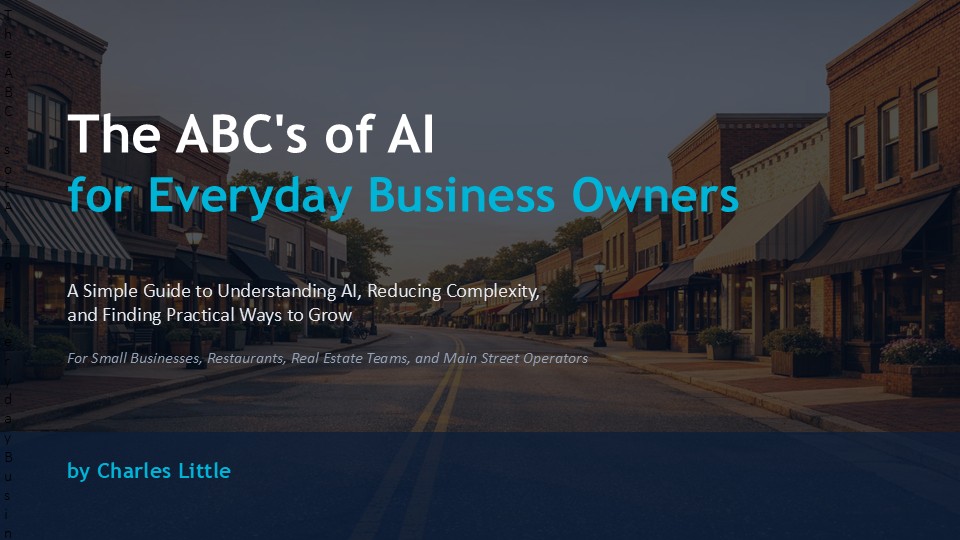
The ABC’s of AI for Everyday Business Owners
A simple, friendly guide to understanding AI, reducing complexity, and finding practical ways to grow your small business — presented by Target Stream Media, Wilmington, NC.
Why This Conversation Matters for Main Street Businesses
If you run a restaurant, a real estate team, a boutique, or any Main Street business, you have probably heard the hype: “AI will change everything.” “You need AI now.” “Automation is the future.” Meanwhile, you are thinking about tonight’s dinner rush, next weekend’s open houses, or how to keep your staff schedule covered without burning out your team.
The real questions most owners are asking are much simpler: Will this help me sell more? Will this save me time? Will this reduce headaches? That gap between big tech promises and everyday business reality is exactly where this AI Guide from Target Stream Media is focused. We are not here to sell you on the latest shiny tool. We are here to help you decide, in plain language, if and how AI fits your business at all.
📌 Key Takeaway: AI should make your business simpler, not more confusing. If it feels like one more thing to manage, it is not the right fit or not set up correctly.
First Things First — What Is AI, Really?
Let’s strip away the jargon. Artificial Intelligence (AI) is simply technology designed to help machines perform tasks that usually require human thinking. That might sound big, but in practice, the AI you will use in your business is usually doing a few very down-to-earth things extremely well.
Answer questions — like a smart FAQ that can respond instantly, 24/7.
Organize information — sorting messages, notes, or leads so nothing slips through the cracks.
Respond faster — sending quick, accurate replies before a customer looks elsewhere.
Automate repetitive tasks — such as reminders, confirmations, or review requests.
Improve customer communication — making sure people feel heard and informed without you typing every message by hand.
Think of AI like a very fast, very consistent assistant. It follows rules, recognizes patterns, and handles routine work. It does not get tired, it does not forget, and it does not need weekends off. But it also does not understand your business the way you do, and it does not replace your judgment, relationships, or experience.
💡 Pro Tip: Most AI tools you will see are narrow — they do one thing well, not everything. That is good news. You do not need a robot CEO; you need a reliable helper for specific jobs.
Generative AI vs. Practical Business AI: Create Things vs. Do Things
When people talk about AI For Small Business, they are usually referring to two main categories of tools. Understanding the difference helps you pick the right solution instead of feeling overwhelmed by options.
Generative AI: Creates Things
Generative AI tools help you create content. They can draft social media posts, write email newsletters, suggest ad copy, or even design simple images and flyers. For a restaurant, that might mean fresh Instagram captions and weekly specials emails. For a real estate team, it might mean listing descriptions, blog posts, or neighborhood guides written in minutes instead of hours.
Practical / Agentic AI: Does Things
Practical or “agentic” AI tools help you do work automatically. They answer calls, book appointments, send follow-ups, manage reviews, and handle routine customer questions. Think of an AI receptionist that can take a reservation at 10:30 p.m., or an AI assistant that instantly texts back a new lead who fills out a form on your website.
Most small businesses see the biggest impact from this second category — the AI that automates daily operations. But you do not have to choose one or the other. Many modern tools combine both: they can create content and handle routine tasks behind the scenes.
📌 Key Question: Are you trying to create content or automate a process? Your answer points you toward the right kind of AI tool.
Why Small Businesses Should Care About AI (Without Becoming “Tech People”)
Most owners we talk to in Wilmington and beyond do not want more software, more dashboards, or more logins. You do not need “more technology.” You need solutions to real problems: missed calls, slow follow-up, staff burnout, and customers slipping away because no one had time to respond quickly.
Efficiency: AI helps you do more with the same team by taking routine tasks off their plate.
Customer Experience: Faster, more consistent responses mean fewer dropped balls and happier customers.
Competitive Edge: The same tools big companies use are now affordable for small businesses, helping you level the playing field.
With the right AI Implementation, a five-person team can deliver a level of responsiveness and consistency that used to require fifteen people. This is not about replacing your staff. It is about freeing them to spend more time with guests, clients, and community members — the things that actually grow your business.
Across industries, businesses using AI tools report 20–40% time savings on routine tasks. For a busy restaurant, that might mean your front-of-house team no longer has to juggle every phone call during the dinner rush. For a real estate office, it might mean your agents spend more time touring homes and less time chasing paperwork and reminders.
Everyday Pain Points AI Can Actually Fix
Let’s get specific. Here are common headaches we see across restaurants, real estate teams, and Main Street operators — and where AI can quietly step in to help:
Missed calls and after-hours inquiries — every missed call is a missed reservation, showing, or sale opportunity.
Repetitive customer questions — “What are your hours?” “Do you have parking?” “Is this listing still available?”
Manual scheduling and appointment juggling — back-and-forth texts and calls to find a time that works for everyone.
Inconsistent follow-up — leads get cold because no one had time to respond quickly or follow up again.
Social media and review management — posts and responses only happen when someone remembers at the end of a long day.
As you read that list, ask yourself: Which of these sounds like my business? These are not “technology problems.” They are time and bandwidth problems — and those are exactly the kinds of problems technology can solve when used well.

Automating routine calls and messages frees owners to focus on guests and growth.
The ABC Framework for Business AI: A Simple Decision Tool
To keep AI from becoming another overwhelming buzzword, Target Stream Media uses a simple three-step framework. Think of it as your filter for every AI pitch, ad, or idea you come across:
A = Assess Your Pain Points — What is actually costing you time, money, or customers?
B = Basic Fit — Is this the kind of problem AI is good at solving?
C = Choose Carefully — Not all tools are created equal; pick the right one for your needs.
Walk through these three steps before you sign any contract or swipe your card. If a tool does not clearly pass all three, skip it. This keeps you out of “shiny object” territory and focused on practical, measurable results.
A — Assess Your Pain Points
Start with your day, not with the software. Where does your time actually go? Where does your team feel stretched the thinnest?
Identify your biggest time wasters: What tasks eat up hours every week but do not require your unique expertise?
Spot repetitive patterns: What do you or your team do over and over that follows the same basic steps?
Find customer bottlenecks: Where do customers get stuck, wait too long, or give up?
A simple exercise: Write down your top three daily frustrations. Maybe it is “answering the same questions,” “chasing no-show appointments,” or “keeping up with messages.” Chances are, at least one of those has a strong AI solution available today.
💡 Remember: Do not start with the tool. Start with the problem. Your assessment drives everything else in your AI Implementation plan.
B — Basic Fit: Where AI Works Best (and Where It Does Not)
Once you know your pain points, ask: Is this the kind of job AI is actually good at? AI shines in a few specific areas:
High-volume, repetitive tasks (answering FAQs, sending reminders, logging information)
Fast response requirements (replying to new leads within minutes, not hours)
Data organization and pattern recognition (sorting leads, tagging conversations, tracking reviews)
24/7 availability needs (after-hours calls, late-night website chats, weekend inquiries)
AI does not do well with:
Nuanced human judgment calls (complex negotiations, sensitive pricing decisions)
Deeply personal or emotional conversations (handling serious complaints or crises)
Creative strategy (deciding your brand voice, setting your long-term vision)
Use this simple basic fit test: Is the task repetitive? Does it follow clear rules? Would faster response help? If you answer “yes” to two or more, it is likely a good AI candidate. Auto-responding to inquiries, scheduling, review requests, and FAQ handling are all strong fits. Handling a heated complaint from a long-time customer is not.
C — Choose Carefully: Smart Tool and Vendor Selection
Once you know the problem and confirm it is a good AI fit, it is time to pick a tool. This is where many owners get stuck or burned. Here is how to keep it simple and safe.
Red flags to watch for:
Long-term contracts with no trial period
No clear ROI metrics or case studies for businesses like yours
“We do everything” claims that sound too good to be true
Explanations full of jargon instead of plain language you understand
Green flags to look for:
A free trial with clear goals
Simple, transparent pricing with no surprise fees
References or testimonials from local businesses like yours
Hands-on support during setup, not just a link to a help article
Ask every AI vendor three simple questions:
What specific problem does this solve for my business?
How long until I see measurable results?
What happens if it does not work as promised?
Start with one tool that solves one clear problem. Do not try to transform everything at once. Simplicity is your friend.
Real Business Example: A Restaurant Saves Lost Revenue
Imagine a busy neighborhood restaurant. During peak hours, the phone rings constantly, but the staff is focused on guests at the door and tables that need attention. Voicemail fills up, after-hours calls go unanswered, and online reviews mention “hard to reach by phone.”
The Problem: The restaurant is missing an estimated 30% of phone calls during busy times, losing reservations and takeout orders — a revenue leak of $3,000+ per month.
A — Assess: The owner identifies missed calls and after-hours inquiries as the number one pain point and biggest source of lost revenue.
B — Basic Fit: An AI receptionist is a strong fit: high volume, repetitive questions, and a clear need for 24/7 availability.
C — Choose: The restaurant selects a tool with restaurant-specific training, no long-term contract, and built-in reporting on captured calls and orders.
Within weeks, the AI receptionist is answering calls, taking reservations, handling common menu questions, and sending polite review requests after each visit. The staff spends more time with guests in the dining room and less time tied to the phone. The owner can clearly see the number of calls and orders captured that used to be missed.
Key takeaway: One focused AI tool, chosen with the ABC framework, plugged a major revenue leak without adding complexity to the owner’s day.
Real Business Example: A Real Estate Office Responds Faster
Now picture a small real estate office with a handful of busy agents. Leads come in from online listings, website forms, and social media. By the time an agent is free to respond, the buyer has already spoken with another agent or scheduled a showing elsewhere. Meanwhile, agents spend hours writing listing descriptions and follow-up emails.
The Problem: Leads are going cold, and marketing tasks like listing descriptions are eating up valuable selling time.
A — Assess: The broker identifies slow lead response and content creation as the biggest bottlenecks holding the team back.
B — Basic Fit: AI lead capture and auto-follow-up are ideal — speed matters, and responses can follow clear templates. Generative AI is also a great fit for listing descriptions and email drafts.
C — Choose: The office selects tools that integrate with their CRM, include real estate–specific templates, and provide clear metrics on lead response time and conversion.
The result: every new lead gets an instant, friendly text or email, even at night or on weekends, acknowledging their inquiry and asking a few qualifying questions. Agents receive a summary and can follow up personally when they are free. AI-generated listing descriptions and emails save the team five or more hours a week, which they reinvest in showings, negotiations, and client relationships.
Key takeaway: AI did not replace the agents. It gave them more time to do what only they can do: build trust and close deals.
What AI Should Not Do in Your Business
Responsible AI use means setting clear boundaries. To keep things simple and safe, there are a few jobs AI should not handle for your business:
Making final legal, medical, or major financial decisions for your business
Handling highly sensitive personal data without proper security and compliance
Being the only customer touchpoint for complex, emotional, or high-stakes situations
Operating without human oversight — there should always be a human in the loop.
The goal is augmentation, not replacement. A helpful rule of thumb: let AI handle the 80% that is repetitive and predictable, and keep the 20% that requires your experience, empathy, and judgment.
Common Myths About AI for Small Business
As you explore AI For Small Business, you will run into a few myths. Let’s clear them up quickly:
Myth 1: “AI is too expensive for small business.” In reality, many tools start at $100–200 per month and often pay for themselves in the first week through saved time or recovered revenue.
Myth 2: “AI will replace my employees.” Most successful implementations use AI to handle routine tasks so your team can focus on higher-value work, not to cut staff.
Myth 3: “AI is too complicated to set up.” Modern tools are increasingly plug-and-play, with guided setup and support. You do not need to be “techy” to get value from them.
Myth 4: “AI is only for big companies.” In practice, small businesses often see faster ROI because they can implement and adapt more quickly than large organizations.
The biggest myth of all is that you need to understand how AI works under the hood to benefit from it. You do not. You just need to know what problem you are solving and whether the numbers make sense.
How to Think About ROI: Is AI Worth It?
When you consider any AI tool, look at return on investment in simple, practical terms:
How many hours per week does this task currently take?
What is the cost of not solving this problem? (missed calls, lost leads, slow response, poor reviews)
How quickly will I see measurable results?
If a $150/month tool saves you 10 hours a week, that is less than $4 per hour for a virtual team member that never calls in sick. If missed calls are costing you $500 per week in lost business, a $150/month AI receptionist has a 3x or better ROI as soon as it plugs the gap.
Time is your most valuable resource. AI ROI is measured in hours reclaimed and stress reduced, not just dollars saved. Track results for 30 days. If the numbers work, expand. If not, you have learned a lesson at a low cost and can move on.
A Simple Deployment Process: 5 Steps, 30 Days
Adding AI to your business does not have to feel like a massive IT project. Here is a straightforward rollout process many Main Street businesses can complete in a month:
Step 1: Identify — Pick one specific problem to solve first (missed calls, slow follow-up, repetitive questions).
Step 2: Research — Find 2–3 tools built for that problem. Read reviews from similar businesses and ask peers for recommendations.
Step 3: Pilot — Run a 2–4 week trial with clear success metrics (calls answered, leads captured, hours saved).
Step 4: Measure — Compare before-and-after numbers: time, revenue, customer feedback.
Step 5: Expand — If the pilot works, integrate it fully and consider the next problem to solve.
The keyword is simple. You are not rebuilding your entire tech stack. You are adding one helpful assistant at a time.
Start Small, Grow Smart
You do not need to “AI everything” at once. In fact, the businesses that see the best results take a phased approach:
Days 1–30: Pick one tool for one problem. Get comfortable. Measure results.
Days 31–60: Optimize that first tool. Train your team. Document what is working and what is not.
Days 61–90: Consider adding a second tool based on what you have learned and where you still feel bottlenecks.
Avoid the “big bang” approach. Gradual adoption has a much higher success rate and keeps your focus on real results instead of chasing the latest trend.
The Human Advantage Still Matters Most
At the end of the day, your biggest advantage is not your software. It is you and your team. AI can help you run a smarter, simpler business, but it cannot replace the relationships you have built in your community.
Relationships: Your customers choose you because of the way you treat them, remember them, and show up for them.
Trust: People buy from people they trust. AI can support that trust with consistent communication, but it does not create it.
Community: Local businesses are anchors in their neighborhoods. Your involvement, generosity, and personality cannot be automated.
Judgment: Complex decisions, creative problem-solving, and empathy require human intelligence.
Think of AI as an amplifier. It handles the routine so you can spend more time on the human moments that matter most. The winning formula is simple: AI handles the routine, you deliver the relationship.
Key Takeaways and Your Next Step
AI does not have to be overwhelming or mysterious. For most small businesses, the real question is not, “How do I use AI everywhere?” It is simply, “What problem do I want to solve?”
AI is a tool, not magic. It works best on repetitive, rule-based tasks and fast responses.
Use the ABC Framework: Assess your pain points, check for Basic Fit, and Choose Carefully.
Start with one problem and one tool. Keep it simple and measurable.
Expand only when the numbers support it and your team feels comfortable.
Your human advantage — relationships, trust, and community — remains your strongest asset.
Your next step is simple: identify your single biggest daily frustration and explore one AI tool that directly addresses it. That is it. No buzzwords, no pressure to “keep up with technology,” just a practical step toward a simpler, smarter business.
Thank You — Let’s Connect: Presented by Target Stream Media, Wilmington, NC
At Target Stream Media, our goal is not more complexity. Our goal is smarter, simpler business for local owners like you. We help restaurants, real estate teams, and Main Street operators understand and implement AI in a way that feels practical, friendly, and manageable.
Our services include AI-powered marketing, digital strategy, automation setup, and ongoing support — all designed with small businesses in mind. We are based in Wilmington, North Carolina, and we understand what it means to serve a local community while trying to keep up with a changing digital world.
Ready to explore your options? Visit targetstream.net to schedule your free AI readiness assessment. No pressure, no commitment — just a conversation about where AI might make your business simpler, not harder.
