AI Governance for Multi-Unit Restaurants
AI governance, Multi-unit restaurant AI, Franchise restaurant operations
AI Integration and Governance for Multi Unit and Franchise Restaurant Operations
How multi-unit and franchise operators can deploy AI with enterprise-grade governance, protect guest data, and turn every call, click, and inquiry into measurable revenue.
1. The Multi-Unit Problem: Fragmentation at Scale
Independent operators already juggle fragmented technology, POS, online ordering, reservations, delivery apps, scheduling, and review platforms that do not talk to each other. Most are paying for at least five systems and getting half the value. For multi-unit and franchise restaurant operations, that fragmentation multiplies by every store, every market, and every franchisee tech stack decision.
National restaurant brands and franchisors solved this with ERP style solutions and custom integrations years ago, at a cost that made sense for 500 units, not for a regional group with 12 locations and a lean support team. Some SaaS cloud platforms have been developed to address this in the mid market but many fall short of the expectation. Historically, Main Street restaurant groups had two options: overpay for enterprise tools and subscription costs that were sometimes a stretch on the budget and/or poorly supported. AI is rewriting that equation by becoming the coordination layer on top of the tools you already have, not another disconnected system you have to manage.
National Restaurant Association research shows that 83% of adults use smartphones or tablets to explore restaurant options, and 55% rely on reviews before deciding where to dine. The National Restaurant Association’s 2030 outlook projects that technology, personalization, and off-premise channels will continue to drive sales growth, with total industry revenue projected to reach roughly $1.2 trillion by 2030. With that said the current out look for restaurant operations shows a tightening bottom line where driving sales and efficiencies becomes increasingly important to success. Personalized and localized marketing are no longer nice-to-have; they are the competitive standard. At multi-unit scale, AI enabled media tools and business solutions offer the the main street restaurant the extra edge needed to prosper and to deliver that level of relevance and responsiveness across dozens or hundreds of locations.

Centralized AI dashboards turn scattered location data into actionable decisions.
2. The AI Inflection Point: Adoption Is Not Optional
AI is no longer a future bet, it is a current operational reality. Voice ordering, predictive inventory, automated scheduling, and AI enabled restaurant management tools are already in-market. Guests are using AI-driven search, maps, and recommendations to choose where to eat. Delivery platforms quietly optimize your visibility with their own algorithms. The question is not whether your restaurant group will be touched by AI. It is whether you will deploy it on your terms, with governance, or have it deployed to you by everyone else in the value chain, or that innovative tech forward franchisee who launches Shadow AI across your franchise network.
We hear the same FUD from operators in every market: Fear, Will AI replace our people, expose guest data, or make decisions we cannot control? Uncertainty, What happens to our proprietary recipes, guest lists, and loyalty data once they touch an AI system? Doubt, Can we trust AI to be secure, ethical, and compliant with emerging regulations?
The honest answer: AI deployed without governance deserves that fear. But AI deployed under a clear governance framework, with boundaries, audit trails, and role-based access, becomes one of the safest, most accountable systems in your stack. In our “AI for Small Business: A Practical Guide”, we outlined how smaller enterprises can move from overwhelmed to operational with practical first steps. Multi-unit restaurant operators have the same opportunity, with more upside. The AI revolution is finally giving Main Street and regional restaurant groups a way to compete with national brands on responsiveness, personalization, and restaurant marketing technology, without enterprise IT budgets.
📌 Key Takeaway: The biggest risk is not moving slowly — it is deploying AI without governance, visibility, or control.
3. Zero Trust AI: The Governance Framework Restaurants Need
The most dangerous AI deployment for a restaurant group is not the wrong model, it is the wrong environment. Letting staff drop guest complaints, reservation details, or internal policies into consumer AI tools is a governance failure, not a productivity hack. Public consumer AI tools were never designed to handle PCI Compliance, Soc2, or internal franchise information cyber security requirements at any scale.
3.1 The Risks of Consumer and Public AI Tools
Loss of confidential information: recipes, vendor pricing, and training docs pasted into personal AI accounts with no way to retract them.
No centralized monitoring: leadership cannot see who is using what, or what guest data is being exposed.
Accidental disclosure: shared chat links, screenshots, and copied outputs that leak sensitive information across teams or outside the company.
External model training: confidential inputs may be used to improve public LLM models, outside of your control.
This is why AI governance for restaurants cannot be an afterthought. As we put it with every client: “If you can’t protect guest, employee, and company data, you shouldn’t deploy it.”
3.2 Private "API" LLMs and Zero Trust AI
Zero Trust AI starts from a simple premise: do not automatically trust any user, device, or agent and verify everything. This is an extension of the Zero Trust Architecture protocols currently being deployed in the largest enterprise networks across the globe. The difference is not the underlying model; it is the control layer wrapped around it. In the Target Stream Zero Trust Architecture protocol, every model is accessed through a secured, private API environment, not through consumer apps, and every action is logged, permissioned, and auditable.
Administrator controls: Centralized authentication, roles, and permissions across your group or franchise network.
Full logging and audit trails: Every call, message, and AI decision is recorded and and can be reconstructed.
Controlled knowledge base: A curated, versioned library of menus, policies, brand standards, and FAQs, not random uploads by individual employees.
Standardized prompts and brand voice: AI outputs aligned with your tone, compliance requirements, and franchise agreements, with no external model training on your data.
When a guest complains about what your AI said, you need to answer a simple question: “What exactly happened?” That is why we also say, “If you can’t document, monitor, and audit AI, you shouldn’t deploy it.” In 2026, industry research shows that fewer than 20% of organizations have mature AI governance — yet communications risk is rising. Zero Trust AI closes that gap by design, not by policy alone.
3.3 Target Stream’s Zero Trust AI Certification
Every subscription instance of the Target Stream AI Business Hub operates under our internal Zero Trust AI Certification. Oversight is architected into the core platform, not layered on later. We align with the NIST AI Risk Management Framework and design for GDPR, CCPA, and PCI resilience from day one. Real-time dashboards flag deviations, and governance rules can be updated centrally as legal standards or brand conditions change.
For multi-unit and franchise restaurant operations, this turns compliance into a differentiator. You can move at startup speed, testing new Agentic AI restaurant workflows, phone automation, and guest messaging, while demonstrating national-brand rigor in data protection and accountability.

Zero Trust AI turns every agent interaction into auditable, defensible records.
4. Example: The Agentic Phone Host; Speed-to-Answer as the Revenue Wedge
The phone is still where your highest-intent guests reach you, and it is still the channel your team is least able to answer. The host is seating. The manager is handling an issue. Your Bar Keep is busy serving customers. Its rush and the restaurant is just busy. Who picks up the phone? For multi-unit operators, every missed call is not just a service failure; it is a compounding revenue leak across locations and day parts. This is where a sophisticated restaurant phone automation and phone answering solution becomes a strategic wedge, not a gadget.
The “AI Agent Basics” article breaks down how AI agents work in plain language. The Agentic Phone Host is one such agent, a governed, role-specific AI that answers every call in natural conversation, within the guardrails you define. One agent can serve every store, every brand in the group, and every franchise location, while respecting local menus, hours, and policies.
Answers every call, day or night, in natural, brand-aligned language.
Books, changes, and confirms reservations directly into your existing systems.
Captures catering, private event, and large-party inquiries with structured details.
Answers hours, locations, parking, menu, and allergen questions consistently and accurately.
Routes edge cases to a manager with context; including caller ID, intent, and notes.
Missed-call economics add up quickly. A handful of missed calls per week, per location, especially in catering-heavy concepts, can translate into thousands of dollars in lost restaurant lead generation every month. With the Agentic Phone Host, you also get reporting you have never had before: received, answered, missed, recovered, and booked, broken down by store, day part, and campaign. All calls and conversations are transcribed and the AI monitored and judged. All transcripts are added to the CRM for deep analytics. As we tell operators, “Let the AI answer the phone so the team can run the restaurant.”
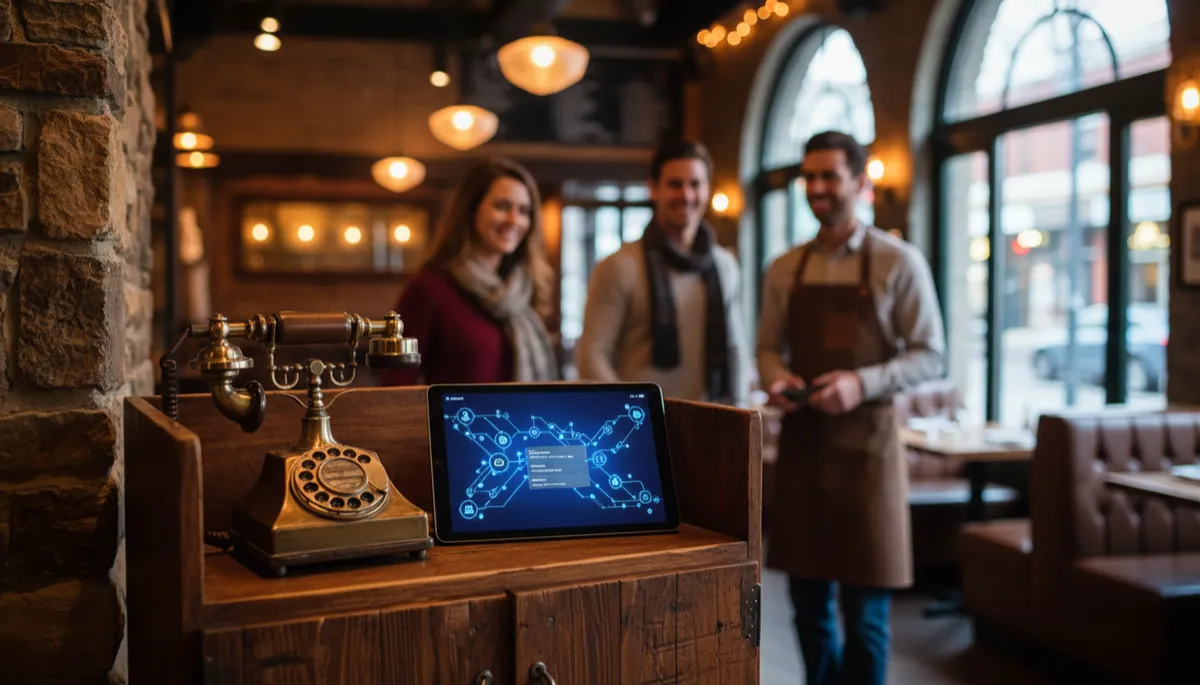
An Agentic Phone Host protects revenue by answering every high-intent call.
5. The Full Guest Journey: From Answered Call to Lifetime Guest
Answering the call is step one. The real value comes from connecting that call to a full guest journey, one that your team does not have to manually orchestrate. In the Target Stream “AI Content Strategy for Local Businesses” guide, we showed how AI can handle content at scale across locations. The same principle applies to guest journeys: once a conversation is captured, AI can carry it forward consistently and profitably.
Inquiry answered: Phone, web chat, or SMS is handled by a governed AI agent that collects the right information every time.
Qualified: Date, time, party size, budget, occasion, and requirements (allergens, AV, private room needs) are captured and stored in the AI Business Integration Hub.
Booked: A reservation, catering order, or event inquiry is created in your existing PoS or Reservation systems or in a simple shared pipeline.
Followed up: AI-driven follow-ups, via text or email, continue until the inquiry converts or clearly closes out, with human oversight.
Re-engaged: After the visit, the system requests reviews, invites guests into approved marketing programs, and nurtures them toward loyalty.
The highest-value expansion for most groups is catering and private events. One after-hours event inquiry converted into a 60-person buyout often more than covers a year of subscription fees. This is where AI-driven restaurant lead generation becomes a revenue engine, not just an efficiency play, especially when paired with the community-building strategies we covered in “Finding Your Tribe.”
💡 Pro Tip: Treat every call, text, and chat as the start of a guest record — not a one-off interaction. AI makes that practical at scale.
6. The Multi-Unit Restaurant AI Coordination Layer
For multi-unit and franchise restaurant operations, the real unlock is centralization with local control. The AI does not replace your operating playbook design kits or brand voice, it enforces it, while giving each store the flexibility they need to serve their market. This is the coordination layer national brands built with custom integrations. Today, multi-unit restaurant AI can deliver similar outcomes at Main Street budgets.
Corporate and franchisor controls: Brand standards, AI policies, approved knowledge bases, marketing templates, governance rules, and reporting dashboards are set centrally and connected to franchise core reporting tools and databases.
Location-level flexibility: Local hours, menus, specials, holiday schedules, and manager escalation rules are managed per store, within guardrails.
Coordinated guest experience: Every guest receives the same quality of initial response, while being routed to local humans for judgment and hospitality.
This coordination layer extends beyond calls. When you combine it with the social media guardrails discussed from our “Social Media Standards for Restaurants Guide” and the content automation strategies from “AI Content Strategy for Local Businesses,” you get a full-stack system: governed agents at the front door, consistent brand voice online, and location-aware messaging and content creation that respects franchise boundaries.
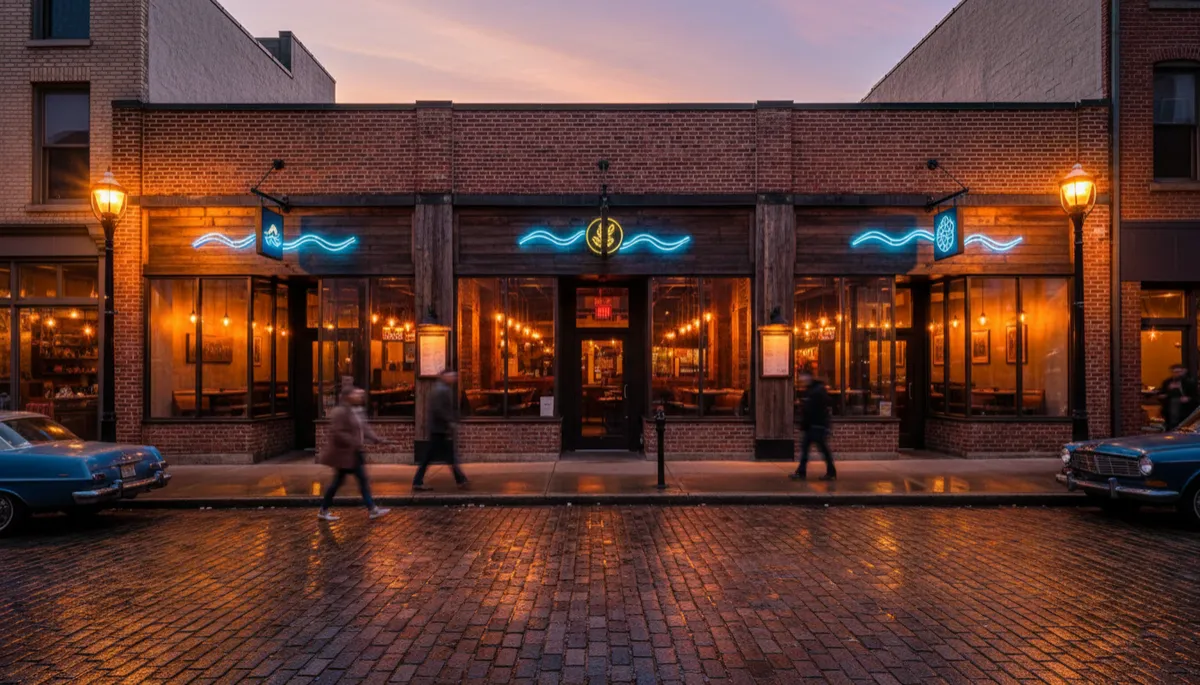
Centralized AI keeps multi-unit brands consistent while honoring local character.
7. Integrating AI with the Modern Restaurant Marketing Stack
AI does not replace the fundamentals of restaurant marketing, it amplifies them. You still need a strong website, clean local SEO, active social channels, and disciplined reputation management. What changes is what happens after a guest finds you. The National Restaurant Association’s 2030 projections emphasize the role of technology and mobile, with 83% of adults using smartphones to explore options, the “AI enabled digital front door” has become just as important as your physical one.
A guest discovers you via search, social, or a targeted campaign. It is 10:30 p.m. They call, text, or open chat. In a traditional stack, that interaction is either missed or handled inconsistently. In an AI-augmented stack, governed agents answer instantly, qualify the opportunity, and plug it into your systems. This is practice, not theory, and it is where the AI Business Hub at Target Stream is designed to live.
The principles we laid out in our earlier restaurant marketing resources still apply: personalization at every touch point, data-driven insights, and hyper-local targeting. The difference is that AI now executes these automatically and at scale, generating content, responding to guests, and closing loops that used to fall through the cracks. For franchise restaurant operations, that means less variance between locations, fewer missed opportunities, and clearer ROI on every marketing dollar.
8. The Bottom Line for Multi-Unit Operators
The fragmentation problem: Multiple disconnected systems across multiple locations drain time, create inconsistency, and hide revenue opportunities.
AI governance must come first: Public tools and unmanaged agents expose guest data and brand risk. Governance is not optional, it is foundational.
Zero Trust AI is the framework: Private API access, role-based controls, logging, and auditability aligned with NIST and global regulations let you move fast with risk manged and without losing control.
The Agentic Phone Host is the entry point: Restaurant phone automation that answers every call and captures every opportunity is the fastest path to visible ROI.
The guest journey is the revenue engine: From first inquiry to review and re-engagement, AI-led workflows increase conversion, average check, and lifetime value.
The coordination layer is the scale play: A governed AI layer lets you operate with national-brand discipline while preserving the heart of Main Street hospitality.
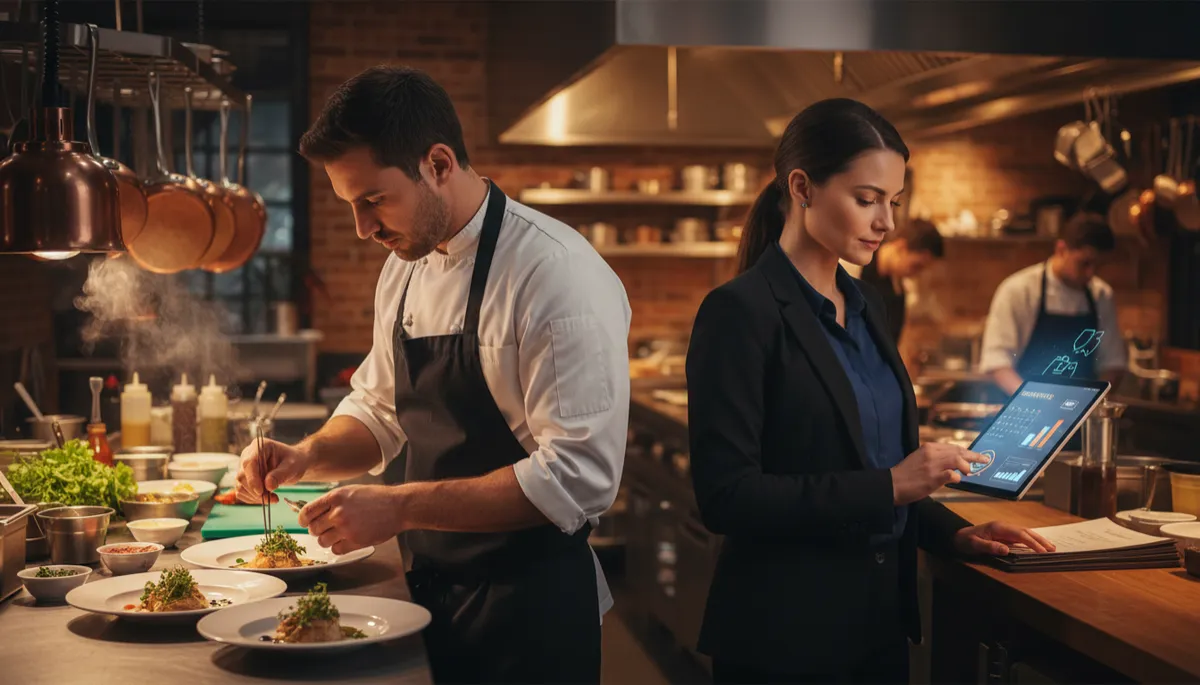
When AI handles coordination, your team can focus on food and hospitality.
9. Your Next Step: AI Business Solutions for Main Street
If you are responsible for a multi-unit group, a franchise territory, or a growing independent brand, you do not need another vague AI trend report. You need a concrete path from where you are to a governed, revenue-ready AI deployment — one that respects your people, your guests, and your brand.
Step 1: Book Your 30-Minute Restaurant AI Readiness Snapshot. We review your current stack, identify the highest-impact use cases, and map your governance gaps. Start at targetstream.net or reach out directly at our contact page.
AI is reshaping restaurant operations on every level, from the National Restaurant Association 2030 projections to the nightly realities of missed calls and overworked managers. With the right integration and governance, it can finally work for Main Street. not just for national chains. Target Stream Media's Restaurant Tool Kit and AI business Integration Hub is built for exactly that: AI Business Solutions for Main Street, delivered with the rigor, transparency, and partnership your brand deserves.
